- How to Write Progress Notes That Pass Utilization Review

How to Write Progress Notes That Pass Utilization Review
Progress notes for utilization review have to show, on each date of service, that the client still meets criteria for a qualifying diagnosis, that symptoms are still impairing daily functioning, that the session delivered a skilled intervention tied to a treatment plan goal, and that treatment is helping or there is clinical reason to expect it will. A reviewer is deciding whether to authorize more care, so every note has to make the case for the next session.
What Is Utilization Review, and Why Do Progress Notes Decide It?
Utilization review is the process a payer uses to decide whether behavioral health treatment is medically necessary and eligible for reimbursement. It happens before treatment starts, as prior authorization; during treatment, as concurrent review when an authorization is about to expire; and after claims are paid, as retrospective review.
Utilization review and an insurance audit get used interchangeably in conversation. Utilization review decides whether to approve care going ahead. An audit examines care already delivered and paid for, and can result in a repayment request. The documentation standard is the same for both, so notes written well for one hold up in the other. Knowing which one you are in changes what you do next. At utilization review you are arguing for the sessions ahead. At an audit you may be defending payment already received, which is the point where your malpractice carrier belongs in the conversation. If a records request has already arrived, how to prepare for an insurance audit covers the response.
Progress notes are central to either process, because they are the only document produced at every date of service. The diagnostic assessment establishes the diagnosis. The treatment plan sets the direction and gets updated periodically. The note is where a reviewer sees the client’s current clinical picture and whether treatment is helping.
In its March 2026 analysis of HealthCare.gov Marketplace plans, KFF found that insurers denied 19 percent of in-network claims in 2024. Among those denials, an unspecified “other” category accounted for 36 percent and administrative reasons for 25 percent, while 9 percent cited a missing prior authorization or referral and 5 percent cited lack of medical necessity. That dataset covers medical and prescription drug claims combined and does not break out behavioral health, though the Centers for Medicare and Medicaid Services (CMS) begins requiring insurers to report behavioral health denials separately with plan year 2027. The same analysis found that consumers appealed fewer than 1 percent of denied claims, and that insurers upheld the original decision in 66 percent of the appeals that were filed.
Most claim denials are not about your clinical writing. The denials that do come down to clinical documentation are the ones you have direct control over, and since appeals are so rarely filed, the note usually has to be right the first time.
What Do Utilization Reviewers Look For?
A reviewer is applying the medical necessity criteria to a specific date of service. Those criteria are consistent across payers:
- A qualifying diagnosis. The client has a current DSM-5-TR / ICD-10 diagnosis that supports the service billed.
- Functional impairment. Symptoms are causing impairment in one or more life domains: occupational, social, academic, or daily living. Reported distress on its own does not meet this criterion.
- An appropriate level of care. The intensity and setting of services fit the client’s clinical picture, and the modality is evidence-based for the diagnosis.
- A reasonable expectation of benefit. There is clinical reason to expect the client will benefit from the treatment proposed, with prognosis, engagement, and the evidence base supporting that expectation. Progress monitoring across the episode is how you demonstrate it.
How to Show Functional Impairment in Every Note
Functional impairment belongs in every progress note, not only in the diagnostic assessment. Reviewers read a single date of service, sometimes without the intake in front of them, and a note that lists symptoms without describing their impact on functioning leaves the reviewer to infer the impairment.
This takes one or two sentences describing how the symptoms are impacting the client’s functioning right now. “Client reports missing two workdays this month and has stopped attending her weekly class” documents impairment. “Client reports feeling depressed” stops at the symptom and leaves the rest blank. Keep it observable, keep it current, and update it as the client changes. For impairment language organized by life domain, see functional impairment documentation.
How to Connect Each Session Note to the Treatment Plan
The golden thread is the visible line running from the diagnostic assessment through the treatment plan into each note and out to discharge. In a progress note, it means the session connects to a goal or objective a reviewer can find in the plan on file. Medical necessity is the standard the record has to meet; the golden thread is the structure that lets a reviewer follow the argument. They work together, and they are not the same thing.
In practice, this can be as simple as a single sentence. “Used cognitive restructuring on two catastrophizing thoughts, addressing the anxiety-reduction goal” connects the session to the plan. Without it, a reviewer sees an hour of therapy with no stated relationship to the treatment plan on file. More on the mechanics in the golden thread in therapy notes.
Progress Note Patterns That Draw a Utilization Review Flag
Certain patterns give a reviewer nothing to approve.
- Subjective sections that summarize mood without impact. “Client reports feeling anxious this week” states a symptom. It does not tell a reviewer whether that anxiety kept the client home from work.
- No measurable outcome anywhere in the record. When no instrument, frequency count, or behavioral marker appears across several notes, a reviewer has no way to evaluate response to treatment.
- Notes that repeat across dates of service. Near-identical notes suggest either that nothing is changing or that the note is not tracking the session. Both readings weaken the case for continued care.
- Interventions described in general terms. “Provided supportive therapy” or “processed feelings” does not describe a service that requires a licensed clinician.
- Continued care with no stated rationale. A note that ends with “continue weekly sessions” asks the reviewer to supply the reason.
- Plan goals the notes never mention. When the treatment plan is disconnected from the notes, the thread breaks, and the reviewer is left to infer the connection or assume there is none.
Treatment plan errors affect every note that references the plan. Therapy documentation mistakes covers them.
How to Write Each Section of a SOAP Note for Utilization Review
SOAP notes for therapists run Subjective, Objective, Interventions, Assessment, Plan. Assessment sits after Interventions because the assessment is your synthesis of what the client reported, what you observed, and what happened in the hour. It cannot be written until the rest of the session is documented.
The example running through this section is an illustrative composite rather than a real client: an adult with F41.1 generalized anxiety disorder, moderate, twelve sessions into weekly cognitive behavioral therapy, with a concurrent review pending.
Subjective: Quote What Still Impairs Functioning
The client’s report of their current symptoms is entered in the subjective section. Choose the content that shows current impairment. A client can report a good week and still meet criteria, but a subjective section made up entirely of good news gives a reviewer a reason to approve discharge instead of more sessions.
“Client reports worry about an upcoming performance review kept him awake three nights this week, estimating four to five hours of sleep. Reports declining a project lead role he wanted because of anticipated presentations. Describes this week as ‘better than last month, still hard.’”
Use a direct quote when the client’s exact words matter. Do not manufacture quotes for effect, and do not fill the section with them.
Objective: Document What You Observed and Measured
The objective section should include presentation, affect, behavior in session, engagement, and any scored measure. Scores belong here because you administered them. The subjective section holds what the client reported.
“Client presented on time, alert, mildly restless with intermittent hand-wringing when discussing work. Affect constricted, congruent. Engaged throughout and completed between-session homework. GAD-7 = 12 (intake 16, session 8 = 13).”
Showing the trend gives the reviewer evidence that the client is benefiting from treatment.
Interventions: State the Skilled Service You Delivered
This section is where the note meets the level-of-care criterion. A reviewer is confirming that the hour required a licensed clinician. Stating the specific technique, the target, and the modality does that.
“Delivered CBT. Used cognitive restructuring on two identified catastrophizing thoughts about the performance review, completing a thought record in session. Introduced graded exposure and collaboratively built a hierarchy for workplace speaking situations, addressing the treatment plan goal of increasing work-related avoidance tolerance.”
Compare that with “processed work anxiety and provided support.” An entry that does not describe a service requiring a licensed clinician is not one insurance is required to cover.
Assessment: Make Your Clinical Reasoning Visible
The assessment section is where your clinical judgment appears in your own words. It is the most important section for proving medical necessity. It should cover where the client stands relative to the treatment goals, any barrier holding up progress, and the diagnostic picture in current terms.
“Client continues to meet criteria for F41.1 Generalized Anxiety Disorder, Moderate. Symptom burden has decreased since intake (GAD-7 16 to 12) and homework completion has been consistent, indicating responsiveness to CBT. Anticipatory anxiety around workplace performance remains the primary functional barrier and has not yet responded to cognitive work alone, supporting the addition of graded exposure at this stage. Sleep disruption persists at three nights weekly.”
That example proves medical necessity by stating the diagnosis, the movement since intake, the barrier, and the reason for the change in approach. Writing the words “medically necessary” is not required when the reasoning is this explicit, and it is also the simplest way to remove any doubt. Putting the phrase in every note is a reasonable habit for exactly that reason. The section-by-section version of this, with weak and strong pairs throughout, is in medical necessity in SOAP notes.
Plan: Show Why the Next Session Is Necessary
The plan tells the reviewer what happens next and why it has to happen. “Continue current treatment” gives them a frequency. A plan that states the next clinical step answers the authorization question directly.
“Continue weekly outpatient CBT. Next session: begin first exposure task from the hierarchy (asking a question in a team meeting) and review the thought record. Client to complete two thought records before next session. Re-administer GAD-7 at session 16. Continued weekly frequency is warranted to complete the exposure hierarchy while anticipatory avoidance remains active at work.”
That last sentence is what a concurrent reviewer needs, and it belongs in every plan section.
How to Write Progress Notes Faster Without Losing Utilization Review Quality
Notes take a long time when you are reconstructing an hour from memory and deciding what to include as you go. A note written against a fixed structure is shorter and faster, because the structure already tells you what to include.
A workable pass through a note:
- Write the subjective section by selecting one or two reported items that show current functional impact.
- Record what you observed and any measure administered, with the prior score for comparison.
- State the intervention by its technique, its target, and the plan goal it addresses.
- Write two or three sentences of clinical reasoning: where the client stands against the goal, what is blocking progress, and how the diagnosis presents now.
- State the next clinical step and the reason continued frequency is warranted.
More on building that speed in efficient therapy documentation.
Should You Use AI to Help Write Progress Notes?
You can, with a firm boundary. AI is genuinely useful for the parts of documentation that are not client-specific: drafting stronger phrasing for a treatment plan objective, building a note template, generating practice scenarios with fictional details, or checking whether your own de-identified language states an intervention clearly.
The boundary is protected health information. Client information belongs in an AI tool only when the client has provided informed consent and the vendor has signed a business associate agreement covering that use, which general consumer chatbots typically have not. Pasting session content into a tool without a BAA is a disclosure, regardless of how the output is used afterward. Scribe products marketed to clinicians vary considerably on this, so read the actual agreement and confirm what the vendor does with your inputs.
Verify every clinical statement the tool produces. A fluent note that misstates what happened in session is a bigger problem than an awkward one that is accurate. And sign only what you would have written yourself. For the current state of clinician-specific tools and the compliance details, see ChatGPT for clinicians.
What to Do If Your Progress Notes Are Already Under Review
Take the request slowly. Start by reading it closely to identify the client, the dates of service, and the documents being asked for, then confirm who is asking and that they have authority to receive the records. Calendar the deadline with margin.
Then assemble what was requested, in complete and legible form, and keep an exact copy of everything you send along with a log of what went out and when. Send what was asked for and no more.
Notes written before you knew the standard get sent as they are. Records are not rewritten after a request arrives, and altering an existing entry is a far more serious problem than a thin note. Where a legitimate omission needs correcting, use your EHR’s addendum function and date it accurately so it is visible as an addendum. If a note is thin, the diagnostic assessment and the treatment plan often supply what it is missing, which is one reason keeping both current matters so much.
Change your practice going forward and leave the existing records alone. If a denial comes back, read the stated reason carefully, since a missing authorization and an insufficient clinical record call for entirely different responses. Appeals are available, and given how rarely they are filed, a well-documented appeal is worth the hour when the clinical record supports it. For a repayment demand, or anything arriving from an attorney instead of a payer, call your malpractice carrier’s risk line before responding.
Frequently asked questions
What is utilization review in mental health therapy?
Utilization review is the process a payer uses to decide whether behavioral health treatment is medically necessary and eligible for reimbursement. It can happen before care starts (prior authorization), while care is ongoing (concurrent review), or after claims are paid (retrospective review). Your progress notes are the evidence the reviewer reads.
How often do insurance companies request progress notes for utilization review?
It varies by payer, plan, and level of care. Many plans cover routine outpatient psychotherapy with no authorization at all, while plans administered through a behavioral health carve-out often authorize an initial block of sessions and review before extending it. Intensive outpatient, partial hospitalization, and residential care generally require authorization and concurrent review. Routine weekly therapy often does not. Your provider manual and your authorization letters are the accurate sources for your own contracts.
What makes a progress note medically necessary according to insurers?
A note supports medical necessity when it shows a current qualifying diagnosis, functional impairment described in observable terms, an appropriate level of care with an evidence-based intervention matched to that diagnosis, and clinical reason to expect the client will benefit from continued treatment. Writing the words “medically necessary” is not required when the note documents targeted care accurately, and including the phrase anyway is a reasonable habit, because it removes any question about what the note is establishing.
Can I get denied reimbursement because of weak progress notes?
Yes. If a reviewer cannot find current impairment, a skilled intervention, or a rationale for continued care in the record, there is no basis to authorize or pay for the service. Documentation problems are correctable going forward, and a denial can be appealed, though appeals are filed on a small fraction of denied claims.
What is the difference between a progress note and a SOAP note?
A progress note is the clinical record of a single session, whatever format it uses. SOAP is one format for writing that note, organized as Subjective, Objective, Interventions, Assessment, and Plan. Every SOAP note is a progress note. Not every progress note uses SOAP. Payers evaluate what the note documents, and the format itself is up to you.
How do I show clinical progress in a note when a client is not improving?
Document the lack of movement plainly, then give the clinical reasoning for what happens next. State the barrier, describe what you adjusted and why, and reference the measure that is not moving. A reviewer can authorize continued care from an honest account of stalled progress with a responsive plan. A note that reports no change and no adjustment gives them nothing to work with.
Is it HIPAA-compliant to use AI tools to write therapy progress notes?
Only under a signed business associate agreement with the vendor. Without a BAA, no client information belongs in the tool, which rules out pasting session content into a general consumer chatbot. You can still use AI without a BAA for de-identified work such as drafting template language or practicing note structure with fictional details.
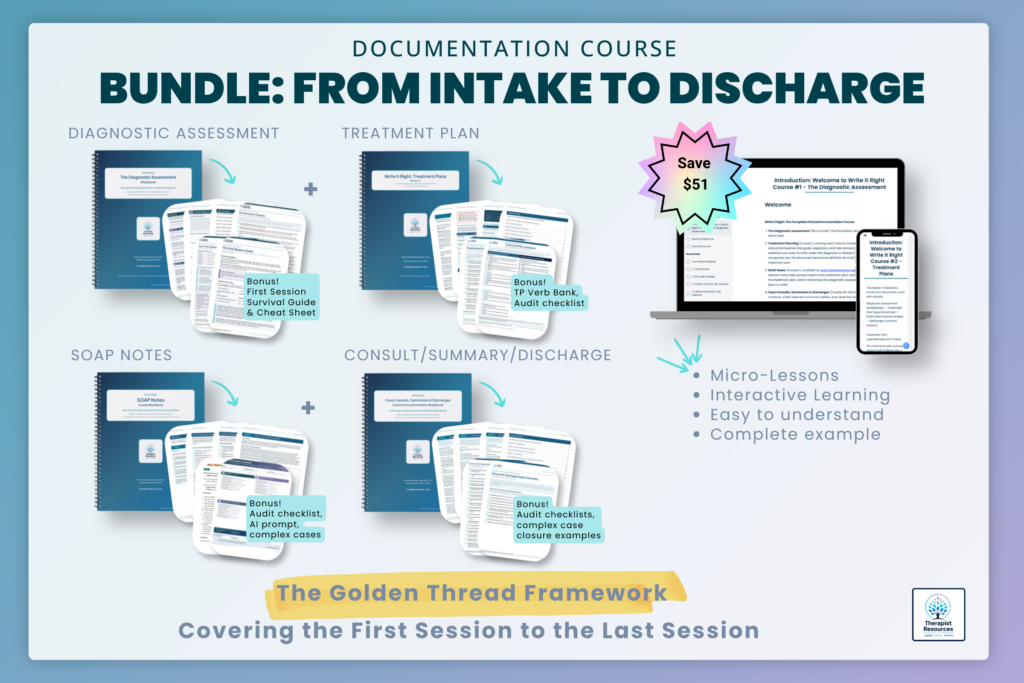
If you want the full section-by-section method with worked examples and practice notes, the Write it Right SOAP Notes course teaches it in depth. If you would rather start from a structure you can use tonight, the Write it Right templates and examples bundle includes the note formats, gold-standard charts, and language these examples are drawn from.
Therapist Resources provides educational content only, not medical, billing, or legal advice. Your payer contracts, provider manuals, and state regulations govern your own documentation requirements. This material is not a substitute for guidance from your malpractice carrier or an attorney during an active review. No provider-client relationship is created through use of these materials. All clinical examples are illustrative composites and contain no real client information. In emergencies, call 911.
therapistresources.com · An Encouragement Ink Brand
- Medical Necessity in Therapy: The Four Criteria Every Note Has to Meet

Medical necessity in therapy is the standard your documentation has to meet for a service to be reimbursable. The chart has to show that treatment was clinically required for this client, and it shows that through four criteria: a qualifying diagnosis, functional impairment, an appropriate level of care, and a reasonable expectation of benefit, demonstrated at every session.
A payer reviewing a claim is asking one question: does this chart show that the treatment was clinically required? Most of the anxiety clinicians carry about audits comes down to that single question, and the reassuring part is that the standard breaks into criteria you can actually document toward.
Medical necessity is not established once at intake and then assumed for the rest of care. It has to be demonstrated at every encounter, and understanding why makes the whole standard easier to meet.
What medical necessity means in therapy
It helps to be precise about what medical necessity is, because it gets used loosely. Medical necessity is the standard that your clinical argument has to satisfy for treatment to be covered. It is the bar the whole record is measured against, not a section in your note or a sentence you paste in.
That distinction matters because it changes what you are aiming for. Rather than dropping in a “medical necessity statement” to check a box, you are documenting care so that a reasonable reviewer, reading the chart, would conclude that the treatment was clinically justified for this client, at this level of care, on this date. When the documentation does that, the standard is met. When it does not, no amount of formatting rescues it.
Medical necessity is also the standard the golden thread exists to satisfy. The two work together and are easy to conflate, so it is worth holding them apart: the golden thread is the structure of the clinical argument across the chart, and medical necessity is the standard that argument has to meet. A chart can be neatly organized and still fail to justify care, and a chart can contain the right clinical content and still be hard to follow. The relationship between the two is worth its own read, and it is covered in golden thread vs medical necessity.
The four criteria
Medical necessity is determined by four core criteria. They do not each belong to a single document. They have to be visible across the chart, and they have to be updated as the clinical picture changes.
Qualifying diagnosis
The client carries a qualifying DSM-5-TR or ICD-10 diagnosis, documented with its code, a severity specifier where one applies, and the clinical rationale that supports it. The diagnostic assessment is where this criterion is usually established in its fullest form, including the differentials you considered and ruled out.
The reason it matters past intake is consistency. The diagnosis should carry forward across the treatment plan, the progress notes, and the discharge summary unless there is a clearly documented clinical reason for a change. A note that documents goals or interventions no longer aligned with the diagnosed condition weakens the justification for that session, because the work and the diagnosis have drifted apart on paper.
Functional impairment
A diagnosis alone does not establish medical necessity. The diagnosis has to be doing something to the client’s life. The chart has to show, in observable and functional terms, that symptoms are causing impairment in one or more domains: occupational, social, relational, academic, or self-care.
This is an easy criterion to document thinly, usually because symptoms feel like enough. “Client reports anxiety” names a symptom but shows no impairment. “Client continues to avoid staff meetings due to panic symptoms and missed two work deadlines this week” shows the symptom landing on the client’s functioning, which is what supports the need for treatment on that date. Every progress note should carry some version of this: what is still impaired, what has improved, what has worsened. A note that identifies no ongoing impairment leaves the case for continued treatment thin.
Appropriate level of care
The recommended treatment has to be the right intensity and setting for the client’s current clinical picture, and the modality has to fit the diagnosis and be evidence-based. This is the criterion that quietly carries the “evidence-based” requirement that other frameworks sometimes list on its own. The treatment setting, the frequency, and the type of therapy all sit here.
At the start of care, the assessment should explain why the recommended setting and intensity are appropriate, which in many outpatient cases means documenting that the client is not in acute crisis requiring a higher level of care, can maintain safety between sessions, and is likely to benefit from the proposed structure. In ongoing notes, the criterion keeps mattering: each note should stay consistent with the current plan and the selected treatment type, and if symptoms escalate or functioning declines, the chart should say why the current level of care still fits or why a transition is indicated.
Reasonable expectation of benefit
There has to be a clinical basis for expecting the client will benefit from the treatment. At intake this shows up as prognosis and treatment rationale. Over time it is supported by progress monitoring, clinical observation, and ongoing treatment planning.
A note demonstrates this criterion by giving a reason to believe treatment is still working or still warranted: measurable progress, partial improvement with remaining impairment, increased skill use, or a sound clinical rationale for continuing to address the barriers in the way. The failure mode is a chart that shows no change over time and no change in strategy, because that pattern reads as treatment that is neither helping nor being adjusted, which is hard to call necessary.
A note on the count. Some payer and vendor resources list a fourth criterion as “evidence-based intervention.” That requirement is real, and it sits inside appropriate level of care, where the modality has to fit the diagnosis and be evidence-based. The four criteria here are the cleaner clinician set: qualifying diagnosis, functional impairment, appropriate level of care, and reasonable expectation of benefit. If you have seen the criteria framed slightly differently elsewhere, that is usually where the difference is.
Why medical necessity has to be shown at every session
The assessment and treatment plan establish the initial argument for care. After that, each progress note has to re-demonstrate medical necessity for the specific service delivered on that date. The opening case does not carry the whole episode on its own.
The reason is the unit of reimbursement. A payer is paying for a date of service, so each date of service has to stand on its own as clinically justified, while staying consistent with the larger story the chart tells. A note shows what remains impaired, which treatment target it addressed, what intervention was used, how the client responded, and why continued treatment is still warranted. The discharge summary then closes the argument by showing what changed and why care ended. This is what people mean when they say the chart proves medical necessity repeatedly rather than once: the same four criteria, re-shown session by session, inside one continuous record.
What the four criteria look like in a real note
A worked case makes this concrete. Marcus T., the running client across the Write it Right series, came in with generalized anxiety disorder. By his fourth session of weekly CBT, his note carries all four criteria without straining for them.
The qualifying diagnosis is stated and current: F41.1 generalized anxiety disorder, moderate, downgraded from severe at intake to reflect his current presentation, with the evidence for the change named. The functional impairment is observable and specific: persistent worry about job performance, panic-like episodes two to three times that week, sleep at four to five hours a night, and a documented note that he attended one team meeting he would previously have avoided. The appropriate level of care holds steady: weekly outpatient individual CBT, consistent with his plan, with graded exposure added this session as an evidence-based intervention matched to the diagnosis. The reasonable expectation of benefit is supported by data and reasoning: his GAD-7 moved from 16 at intake to 14, he completed his first thought record between sessions, and the clinical formulation explains the temporary uptick in panic as expected variability as cognitive work surfaces avoided content, justifying the decision to add exposure now.
None of that required a special “medical necessity paragraph.” It came out of documenting the session accurately against the plan. That is the point worth holding onto: when the four criteria are in your line of sight, a well-written note demonstrates medical necessity as a byproduct of describing the work honestly.
Where medical necessity and the golden thread meet
The four criteria are the standard. The golden thread is how the chart is organized so a reviewer can follow that standard being met from intake to discharge. The assessment establishes the argument for care, the treatment plan translates it into targets and methods, each session note re-justifies the service for its date while staying linked to the plan, and the discharge summary closes the argument. Medical necessity is what each link has to satisfy; the thread is what keeps the links connected.
That is the framework the entire Write it Right series is built on, which is why every course points back to it. If you want the relationship between the two concepts laid out in full, read golden thread vs medical necessity. If you want the per-note mechanics of showing the criteria, how to prove medical necessity in your progress notes walks through a single session.

Frequently asked questions
What is medical necessity in therapy?
Medical necessity is the standard your documentation has to meet for a service to be reimbursable. The chart has to show that treatment was clinically required for this client, beyond simply recording that a session occurred. It is determined by four criteria (qualifying diagnosis, functional impairment, appropriate level of care, and reasonable expectation of benefit) that have to be visible across the chart and updated as the clinical picture changes.
What are the four criteria of medical necessity?
A qualifying DSM-5-TR or ICD-10 diagnosis documented with its code and rationale; functional impairment shown in observable terms across life domains; an appropriate level of care, meaning the right setting, intensity, and an evidence-based modality matched to the diagnosis; and a reasonable expectation of benefit supported by prognosis at intake and progress monitoring over time. Some resources list “evidence-based intervention” as a separate fourth criterion; that requirement sits inside appropriate level of care.
Does medical necessity have to be proven at every session?
Yes. The assessment and treatment plan establish the initial argument, but each progress note has to re-demonstrate medical necessity for the service delivered on that date, because a payer reimburses per date of service. Each note stands on its own while staying consistent with the larger clinical story.
What is the difference between a diagnosis and medical necessity?
A diagnosis is one of the four criteria, not the whole standard. A client can carry a qualifying diagnosis and still fail to meet medical necessity if the chart does not show functional impairment, an appropriate level of care, and a reasonable expectation of benefit. The diagnosis is necessary but not sufficient on its own.
What does “reasonable expectation of benefit” mean?
It means there is a clinical basis for expecting the client will benefit from the treatment: prognosis and treatment rationale at intake, and progress monitoring, partial improvement with remaining impairment, increased skill use, or a sound rationale for addressing remaining barriers over time. A chart that shows no change and no change in strategy weakens this criterion.
What happens if a note does not show medical necessity?
The claim for that date of service is vulnerable in a utilization review or audit, even if the session was clinically valuable, because the reviewer judges the documentation rather than the work. The fix is rarely more words; it is showing the four criteria, with current functional impairment and a clear reason continued treatment is warranted.
If you want to see whether your own charts show the four criteria, the Clinical Documentation Audit Tool is a self-audit you can run on a stack of records in an afternoon. To learn the framework applied document by document, the free Golden Thread and Medical Necessity primer and the full Write it Right series follow one client from intake through discharge.
Therapist Resources provides educational content only, not medical or legal advice. This material is not a substitute for professional help. No provider-client relationship is created through use of these materials. Consult a healthcare provider for medical concerns. In emergencies, call 911.
therapistresources.com · An Encouragement Ink Brand
- How to Prove Medical Necessity in Your Progress Notes (Every Session)
How to Prove Medical Necessity in Your Progress Notes (Every Session)
To prove medical necessity in a progress note, document the four criteria for that date of service: a current qualifying diagnosis, the specific functional impairment the client showed that session, an evidence-based intervention tied to a treatment-plan goal, and a reason continued treatment is warranted. The note proves necessity by describing targeted, responsive care accurately, so a reviewer can approve the claim without reassembling the argument.
The hard part about medical necessity is not understanding it but remembering that you have to show it again in every single note, instead of establishing it once at intake and moving on. A payer reimburses a date of service, so each note has to justify the service delivered on that date, on its own terms, while staying consistent with the larger story the chart tells.
If you want the criteria defined first, medical necessity in therapy: the four criteria covers that ground; here we put them to work.
Why every note has to stand on its own
A reviewer auditing a claim does not read your whole chart and form a general impression. They pull the note for a specific date of service and ask whether that note, on its own, justifies what was billed. The assessment and treatment plan made the opening case for care. After that, the burden shifts to each progress note to re-demonstrate that the service on its date was clinically necessary.
That is why “the client is in treatment for anxiety” is never enough on a given day. The note for that day has to show what was still impaired, what target the session addressed, what you did, how the client responded, and why continued treatment is still warranted. Get in the habit of writing each note as if it were the only one a reviewer will see, because in an audit, it sometimes is.
How to prove medical necessity, note by note
The four criteria of medical necessity carry past intake: each one has a place in a routine progress note.
The qualifying diagnosis is documented in the assessment section as a current diagnosis statement, with the code and severity specifier, updated if the picture has changed. The functional impairment appears wherever you record what the client reported and what you observed: the specific, observable ways symptoms are still affecting work, relationships, sleep, or self-care this week. The appropriate level of care is established by the consistency between what you did and the plan, and by the modality you used being an evidence-based fit for the diagnosis. The reasonable expectation of benefit belongs in the assessment and plan, in the progress you note and the rationale for continuing. None of these requires a dedicated paragraph. They come out of documenting the session accurately, as long as you know to look for them.
Weak versus strong medical-necessity language
The difference between a note that survives review and one that does not is usually specificity. Weak language names a symptom or a vague activity. Strong language shows the symptom landing on the client’s life and ties the work to a goal.
- Weak: “Client reports anxiety.” Strong: “Client continues to avoid staff meetings due to panic symptoms and missed two work deadlines this week.”
- Weak: “Provided supportive counseling.” Strong: “Used cognitive restructuring on three catastrophizing thoughts the client identified in the thought record, addressing Goal 1 (reduce GAD-7 to within functional range).”
- Weak: “Client is making progress.” Strong: “GAD-7 down from 16 to 14; client completed first thought record between sessions; one previously avoided meeting attended this week.”
The strong versions are not longer for the sake of it. Each one carries a criterion: the impairment is observable, the intervention is named and tied to a goal, the progress is measured. A utilization reviewer reading the strong version has what they need to approve the claim. Reading the weak version, they have no basis to, however good the actual session was.
The “client is improving” trap
There is a stretch in many good cases where medical necessity gets harder to document precisely because treatment is working. Scores are dropping, the client is more functional, and a note that says only “client continues to improve” leaves a reviewer with no reason to authorize more care. The improvement becomes an argument against the next session.
The way through is to document the impairment that remains alongside the gains, and to give the clinical reason continued treatment is still warranted. Partial improvement with remaining impairment supports necessity. So does increased skill use that is not yet consistent, a relapse-prevention rationale, or a sound reason to keep addressing the barriers still in the way. A note that shows GAD-7 dropping while panic episodes briefly rise, with a formulation explaining why, is making a stronger necessity case than a note that simply reports good news. Improvement is evidence the treatment is reasonable; remaining impairment is evidence it is not finished.
A worked note
Here is how this comes together in one session. Marcus T., the running case across the Write it Right series, is a software developer with generalized anxiety disorder, four sessions into weekly CBT. His plan goals are to reduce his GAD-7 from 16 to below 9, restore sleep to seven or more hours, and eliminate occupational avoidance, all within twelve weeks. The session was billed 90837.
Reading his Session 4 note for the four criteria:
- Qualifying diagnosis (Assessment). “Client continues to meet criteria for F41.1 Generalized Anxiety Disorder, Moderate, as evidenced by persistent worry about job performance, two to three panic-like episodes this week, sleep at four to five hours per night, and GAD-7 of 14.” The diagnosis is current and carries its evidence.
- Functional impairment (Subjective and Objective). Persistent worry about job performance, panic two to three times that week, sleep at four to five hours, and the observable detail that he attended one team meeting this week that he would previously have avoided. Specific domains, not a global “anxiety.”
- Appropriate level of care (Interventions). Weekly outpatient CBT, consistent with the plan, with cognitive restructuring on the thought record and graded exposure introduced this session, both evidence-based for GAD. The level of care matches the clinical picture.
- Reasonable expectation of benefit (Assessment and Plan). GAD-7 down two points from baseline, first thought record completed, accurate identification of cognitive distortions, and a formulation explaining the temporary panic uptick as expected as avoided content surfaces, justifying the decision to add exposure now. The plan assigns the first exposure trial before Session 5.
This note does not use the words “medically necessary.” It documents the session against the plan, and the four criteria fall out of an accurate account of the work. There is no rule in either direction on whether to include the phrase. A note written this way establishes necessity without it, and I put it in every one of my session notes anyway, because it removes any question about what the note is establishing.
Tying the note back to the plan and forward to the next
One habit makes all of this faster: before writing a note, answer two questions. Which treatment plan goal or objective did this session work on, and what evidence do you have that the work is needed today and likely to help. Let those answers shape the assessment and plan sections, and the note will connect backward to the plan and forward to the next session almost on its own.
That backward-and-forward connection is the golden thread, the structure that keeps each note legible as part of the whole episode. Medical necessity is the standard each note has to meet; the thread is what keeps the notes connected so a reviewer can follow them. The two are distinct jobs, and the difference is worth understanding, which is why it has its own explainer. Written this way, your notes are also far easier to audit, because the next reader, including you, can see the case for care without reconstructing it.
Frequently asked questions
How do you prove medical necessity in a progress note?
Document the four criteria for that date of service: a current diagnosis statement, the specific functional impairment the client showed this session, an intervention that is an evidence-based fit for the diagnosis and consistent with the plan, and a reason continued treatment is warranted. Tie the work to a named treatment-plan goal. The note proves necessity by describing targeted, responsive care accurately. There is no rule in either direction on whether to write the words “medically necessary,” and writing them removes any question about what the note is establishing.
Does each session need to show medical necessity?
Yes. A payer reimburses per date of service, so each progress note has to justify the service delivered on its date, on its own, while staying consistent with the larger chart. Intake establishes the opening case; every note after that re-demonstrates necessity for its session.
What is weak medical-necessity language?
Vague phrasing that names a symptom or activity without showing impact or connection, such as “client reports anxiety” or “provided supportive counseling.” Strong language shows the symptom affecting functioning and ties the intervention to a goal: “client continues to avoid staff meetings due to panic and missed two deadlines this week,” and “used cognitive restructuring on the thought record, addressing Goal 1.”
What standardized measures help show medical necessity?
Brief validated measures like the PHQ-9 and GAD-7, re-administered at intervals, give objective data that anchors both impairment and progress. Record the score in the Objective section, note the change from baseline, and let it support the necessity case. One measure documented across time is worth more than a paragraph of narrative.
How do I show medical necessity when the client is improving?
Document the impairment that remains alongside the gains, and give the reason continued treatment is still warranted: partial improvement with residual impairment, skill use that is not yet consistent, or relapse-prevention rationale. Improvement shows the treatment is reasonable; remaining impairment shows it is not finished. A note that reports only good news gives a reviewer an argument against the next session.
What do utilization reviewers look for?
A current qualifying diagnosis, documented functional impairment for the date of service, an intervention matched to the diagnosis and the plan, measurable progress or a sound rationale for continuing, and a note that connects back to the treatment plan. In short, the four criteria, shown clearly enough that the reviewer does not have to assemble the argument themselves.
If you want to pressure-test your own notes against these criteria, the Clinical Documentation Audit Tool is a self-audit you can run on a stack of charts. To see medical necessity built into the note from the ground up, the Write it Right: SOAP Notes course walks the full Marcus T. record session by session, and the free Foundations primer covers the framework behind it.
Therapist Resources provides educational content only, not medical or legal advice. This material is not a substitute for professional help. No provider-client relationship is created through use of these materials. Consult a healthcare provider for medical concerns. In emergencies, call 911.
therapistresources.com · An Encouragement Ink Brand
- Functional Impairment Language: How to Write It So It Holds Up

Functional impairment language is how you document the real-life cost of a client’s symptoms in observable terms, which is what turns a diagnosis into a justified service. Strong impairment language names the specific, countable disruption (missed workdays, dropped grades, canceled plans), pairs each symptom with what it costs the client, and updates every note to show what has improved and what remains.
A diagnosis tells a payer what the client has. Functional impairment tells them why treatment is necessary, and it is the part of the note where specific, observable language does the heavy lifting. A reviewer is not looking for a label so much as for the label landing on the client’s life, in terms specific enough that anyone reading the chart can see the disruption.
This post is a working reference for that language. It covers why functional impairment carries so much of the medical-necessity weight, the distinction between a symptom and an impairment, and adaptable weak-versus-strong language across the domains where impairment shows up. For the criterion in the context of all four, medical necessity in therapy has the full set.
Why functional impairment is the bridge
Functional impairment is the second of the four criteria of medical necessity, and it does a specific job: it connects the diagnosis to the need for care. A qualifying diagnosis alone does not justify treatment, because a diagnosis describes a condition, not its effect. The impairment is the effect, the documented evidence that symptoms are disrupting the client’s ability to work, study, relate to others, or care for themselves.
That is why payers keep returning to it. They want to see that the diagnosed condition is doing something the client needs help with, and they want it in observable terms rather than clinical shorthand. When impairment is documented clearly, the rest of the medical-necessity case has something solid to rest on, at intake and in every progress note after.
Symptom versus impairment
The distinction that does the work is between a symptom and a functional impairment. A symptom is what the client experiences. An impairment is what that experience costs them in a life domain. Notes that name only the symptom leave the reviewer to infer the impact, and inference is exactly what a defensible chart removes.
“Client reports anxiety” is a symptom with no impairment attached. “Client continues to avoid staff meetings due to panic symptoms and missed two work deadlines this week” is the same symptom shown landing on the client’s occupational functioning. The second version is not longer for its own sake. It carries the impact, which is the part that supports the need for treatment. The habit to build is simple: every time you document a symptom that matters, document what it is costing the client.
Functional impairment by domain
Impairment shows up in different domains, and each has its own observable markers. The pattern is the same across all of them: replace the vague summary with the concrete, countable detail.
Occupational and academic
- Weak: “Work has been stressful.” Strong: “Client missed three workdays this month due to difficulty getting out of bed and declined two project presentations he was assigned.”
- Weak: “Struggling in school.” Strong: “Grades have dropped from a B to a D average over six weeks; client has missed assignments in two classes, attributing it to difficulty concentrating and morning anxiety.”
Social and relational
- Weak: “Client is isolating.” Strong: “Client canceled all three planned social outings this month and has been declining invitations, citing dread and fatigue.”
- Weak: “Marital stress.” Strong: “Increased conflict with spouse, including two arguments this week; client reports withdrawing from shared meals and sleeping in a separate room.”
Self-care and daily functioning
- Weak: “Low motivation.” Strong: “Client reports showering twice in the past week, skipping meals most days, and a backlog of unopened mail and unwashed dishes accumulating at home.”
- Weak: “Not coping well.” Strong: “Client has not refilled a maintenance medication on time this month and missed a scheduled medical appointment, citing difficulty managing tasks.”
Parenting, caregiving, and home management
- Weak: “Overwhelmed at home.” Strong: “Client reports being unable to keep up with the children’s morning routine, missed two of a child’s medical appointments this month, and has left household bills unpaid, attributing it to low energy and difficulty concentrating.”
Safety, documented carefully
Safety-related impairment is documented factually and paired with the clinical response, without overstatement. “Client endorsed passive suicidal ideation without plan or intent, last reported on [date]; safety plan reviewed and the client agreed to continue to monitor and to use the plan’s contacts.” The language stays specific and measured: what was reported, when, and what was done. For risk content, accuracy and restraint protect the client and the record at once.
Writing impairment that updates over time
Functional impairment is not only an intake field. The assessment usually documents the clearest baseline, but every progress note has to show the current state of impairment, which is what keeps the medical-necessity case alive session to session. That means documenting what has improved, what has worsened, and what remains.
A note that says “client attended one team meeting this week that he would previously have avoided, while sleep remains at four to five hours a night” shows both a functional gain and a residual impairment in one line. That is the shape to aim for as treatment progresses: the gains make the case that the treatment is working, and the remaining impairment makes the case that it is not finished. Documenting both is also how you avoid the trap where improvement reads as a reason to stop. The mechanics of carrying this through a full note are covered in how to prove medical necessity.
A quick test for any impairment line
When you are unsure whether a line carries impairment or just summary, ask whether a reader who had never met the client could picture the disruption. “Client is struggling” gives them nothing to picture. “Client missed three workdays and stopped attending her weekly class” lets them see exactly what changed. If you cannot picture it, the line is still a summary.
Two questions get most lines across that bar: what specifically can the client no longer do, or do only with difficulty, and how do you know it (observed in session, reported by the client, or captured on a measure). Answer both and the impairment is on the page rather than in your head.
Where impairment language tends to go thin
A few patterns account for a lot of thin impairment documentation, and they are easy to catch once you know them. The first is the symptom-only note, where the chart records what the client feels but never what it costs. The second is the adjective substitute, where a vague qualifier (“significantly,” “severely”) stands in for the concrete detail that would actually show severity. The third is the copy-forward, where last week’s impairment language is carried into this week’s note unchanged, so the record stops reflecting the client’s current state and a reviewer cannot tell whether anything moved.
The correction for all three is the same. Trade the feeling, the adjective, or the stale line for one specific, current, observable fact about the client’s functioning this week. It takes a few extra words and it is the difference between a note a reviewer trusts and one they question.
Frequently asked questions
What is functional impairment in mental health?
Functional impairment is the disruption a mental health condition causes in a person’s ability to function in life domains such as work, school, relationships, or self-care. It is the documented effect of the symptoms, and it is what connects a diagnosis to the need for treatment in a medical-necessity argument.
What is the difference between a symptom and a functional impairment?
A symptom is what the client experiences, such as anxiety or low mood. A functional impairment is what that symptom costs them in a specific domain, such as missed workdays, dropped grades, or canceled plans. Notes that document only the symptom leave the impact to inference; documenting the impairment shows it.
How do you document functional impairment?
In observable, specific terms tied to a life domain, ideally with countable detail: days missed, tasks left undone, plans canceled, responsibilities dropped. Pair the symptom with its cost (“avoids staff meetings due to panic and missed two deadlines this week”), and update it every note to show what has improved and what remains.
What are examples of functional impairment?
Missing workdays or declining work tasks, falling grades or missed assignments, canceling social plans or withdrawing from relationships, neglecting hygiene, meals, or household tasks, and, when relevant, safety-related concerns documented factually with the clinical response. The strong version always names the specific, observable cost rather than a general state.
Why do payers care about functional impairment?
Because a diagnosis alone does not justify treatment; the impairment does. Payers are deciding whether a documented condition is disrupting the client’s functioning enough to require care, and functional impairment is the evidence that answers that question. Clear impairment language makes the chart more defensible in prior authorization, utilization review, and post-payment audits.
If you want to see whether your notes show impairment or only symptoms, the Clinical Documentation Audit Tool checks your charts against the standard. The framework is taught in the free Golden Thread and Medical Necessity primer, and the Write it Right: SOAP Notes course shows impairment documented session by session.
Therapist Resources provides educational content only, not medical or legal advice. This material is not a substitute for professional help. No provider-client relationship is created through use of these materials. Consult a healthcare provider for medical concerns. In emergencies, call 911.
therapistresources.com · An Encouragement Ink Brand
- Reasonable Expectation of Benefit: The Medical Necessity Criterion That Gets Misread
Reasonable expectation of benefit is the medical necessity criterion that asks for a clinical basis to expect the client will benefit from treatment, not a guaranteed outcome and not a symptom score that falls every session. At intake it rests on prognosis and treatment rationale; once treatment is underway it is carried by progress monitoring and clinical reasoning, including when a client plateaus.
Of the four criteria of medical necessity, the fourth is the one clinicians read wrong most readily. Reasonable expectation of benefit sounds like it asks you to promise the client will improve, or to keep a score moving down session after session. It asks for neither. It asks for a clinical basis to expect that the client will benefit from the treatment, which is a different and more reachable standard.
That misread causes real problems. It makes clinicians anxious when a client plateaus, and it leads to notes that overclaim progress to keep the criterion satisfied. This post sorts out what the criterion actually requires, how to document it at intake and over time, and how to hold it when the client is not visibly improving. If you want the full set of four criteria first, medical necessity in therapy lays them out.
What reasonable expectation of benefit actually requires
Reasonable expectation of benefit means there is a clinical basis for expecting the client will benefit from the proposed treatment. The operative word is expectation. You are documenting a sound clinical reason to anticipate benefit, not guaranteeing an outcome and not certifying that improvement has already happened.
This matters because therapy does not move in a straight line, and the standard was never built to assume it does. A client can have a hard month, a symptom measure can tick up, and the expectation of benefit can remain entirely intact, as long as the chart shows the clinical reasoning behind it. The criterion is about the soundness of the clinical case for continuing, judged the way a reasonable clinician would judge it, not about a number that only ever falls.
How it shows up at intake
At the start of care, reasonable expectation of benefit rests on two things: the prognosis and the treatment rationale. The prognosis is your clinical judgment about how likely this client is to improve with this treatment, supported by the factors behind that judgment. Strengths like a first episode, good insight, motivation, stable functioning, and engagement raise it; documented barriers temper it. The treatment rationale is the case that the modality you are recommending is a reasonable fit for the diagnosis and the presentation.
Together they answer the payer’s intake-stage version of the question: is there a clinical reason to think this treatment will help this person. A diagnostic assessment that documents a thoughtful prognosis and a matched treatment rationale has established the criterion at the level the start of care calls for.
How it shows up over time
Once treatment is underway, the criterion is carried by progress monitoring, clinical observation, and ongoing treatment planning. A note demonstrates it in any of several ways, and they are worth naming because clinicians often think only the first one counts:
- Measurable progress, such as a standardized measure moving in the expected direction.
- Partial improvement with remaining impairment, where some gains are visible and there is still clear work to do.
- Increased skill use that is not yet consistent, which shows the treatment is taking hold.
- A clinically sound rationale for continuing to address the barriers in the way, even when the surface numbers have not moved.
Any one of these supports the expectation of benefit for that stretch of treatment. The reason this matters is that it frees you from documenting a falling score every single week. What the chart needs is a reason to believe the treatment is still working or still warranted, and there are several legitimate forms that reason can take.
The plateau and the maintenance case
The hardest version is the plateau: the client has improved, the score has leveled off, and you are not sure the criterion still holds. It can. A plateau supports continued treatment when the chart shows residual impairment that still warrants care, a relapse-prevention rationale, or a clinical reason the current phase of work is necessary to consolidate gains. The key is that a plateau is documented with reasoning, not left as a flat line a reviewer has to interpret.
What turns a plateau into a problem is silence plus sameness. If the notes show no change in the client and no change in the treatment strategy, week after week, the expectation of benefit weakens, because the chart reads as treatment that is neither helping nor being adjusted. The clinical move, and the documentation move, is the same: when progress stalls, name it, and change something. Revise the plan, shift the intervention, or document the specific clinical reason the current approach still fits. A stall that prompts a documented adjustment supports necessity. A stall that prompts nothing does not.
What weakens the expectation of benefit
It is worth stating plainly, because it is the failure mode to avoid: the expectation of benefit weakens when the chart shows no change over time and no change in strategy. Not a hard month, not a plateau you reasoned through, but a long flat stretch with no movement and no adjustment. That pattern is hard to defend, and it is usually a signal worth heeding clinically as well, because a treatment that is producing nothing and being left unchanged is worth rethinking for the client’s sake before a reviewer ever raises it.
A worked example
Marcus T., the running case across the Write it Right series, shows the criterion holding through a rough patch. At intake his prognosis was documented as good: a first episode of generalized anxiety disorder, strong insight, voluntary help-seeking, and stable work and home functioning, treated with cognitive behavioral therapy matched to the diagnosis. That is the criterion established at intake.
By his fourth session, his GAD-7 had moved from 16 to 14, but his panic episodes had ticked up to two or three that week. Read naively, the uptick looks like treatment failing. The note holds the expectation of benefit anyway, because it documents the reasoning: the panic increase is consistent with expected variability as cognitive work surfaces previously avoided content, the GAD-7 is moving in the right direction, skill use is emerging, and the plan adds graded exposure now in response. The chart shows a clinician watching the data and adjusting, which is exactly what a reasonable expectation of benefit looks like in motion. The full per-note mechanics are in how to prove medical necessity.
Frequently asked questions
What does “reasonable expectation of benefit” mean?
It means there is a clinical basis for expecting the client will benefit from the treatment. It asks for a sound clinical reason to anticipate benefit, documented through prognosis and treatment rationale at intake and through progress monitoring over time. It does not require a guaranteed outcome or a continuously improving score.
Does medical necessity require the client to improve?
Not in the sense of steady, visible improvement every session. It requires a clinical basis to expect benefit, which can be shown through measurable progress, partial improvement with remaining impairment, emerging skill use, or a sound rationale for continuing to address barriers. Therapy is not linear, and the standard does not assume it is.
How do you document expectation of benefit when a client has plateaued?
Document the residual impairment that still warrants care, a relapse-prevention rationale, or the clinical reason the current phase of work is necessary, and if progress has genuinely stalled, change something and note it. A plateau reasoned through in the chart supports continued treatment; a flat line left unexplained does not.
Is maintenance treatment medically necessary?
It can be, when the chart shows a clinical basis for it: remaining impairment, a documented relapse risk being actively managed, or a specific reason continued treatment is preventing deterioration. As with any phase, the expectation of benefit has to be reasoned in the notes rather than assumed.
What weakens the expectation-of-benefit criterion?
A chart that shows no change in the client and no change in the treatment strategy over a long stretch. That pattern reads as treatment that is neither helping nor being adjusted. The fix is clinical as much as documentary: when progress stalls, name it and adjust the approach.
If you want to check whether your notes carry a defensible expectation of benefit, the Clinical Documentation Audit Tool runs your charts against the standard. The framework behind it is taught in the free Golden Thread and Medical Necessity primer and applied document by document across the Write it Right series.
Therapist Resources provides educational content only, not medical or legal advice. This material is not a substitute for professional help. No provider-client relationship is created through use of these materials. Consult a healthcare provider for medical concerns. In emergencies, call 911.
therapistresources.com · An Encouragement Ink Brand
Join The Newsletter
Get bi-weekly field notes on AI, tech, and workflows that help you move from ideas to income, without adding sessions or burning out.