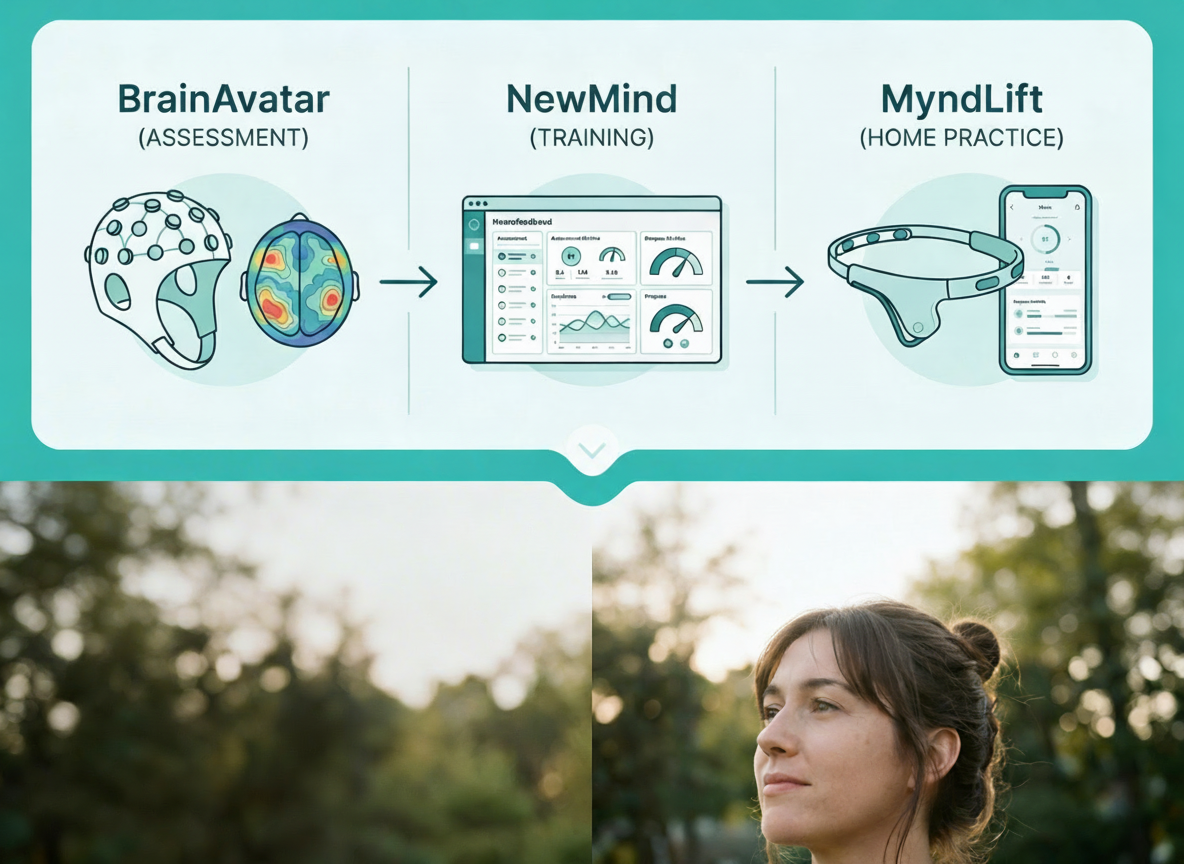
Three Neurofeedback Systems, One Practice: How BrainAvatar, NewMind, and MyndLift Work Together
One of the first questions clinicians ask when setting up a neurofeedback practice is which system to buy. The honest answer is that no single system does everything well. I use three platforms in my practice, each handling a different phase of client care, and the combination works better than any one of them would alone.
Here is what I have learned about BrainAvatar, NewMind, and MyndLift from actually using them.
BrainAvatar: The Assessment Workhorse
BrainAvatar is clinical-grade QEEG software built by BrainMaster Technologies. It runs on BrainMaster’s Discovery and Atlantis hardware and handles everything from raw EEG acquisition to 3D source localization.
What it does well:
– 19 to 24 channel QEEG acquisition with 24-bit resolution
– Z-score analysis against normative databases (via Z-Builder)
– Live sLORETA brain mapping for real-time 3D visualization
– Infra-low frequency training for deep regulatory work
– Continuous impedance monitoring so you catch signal problems before they compromise data
– Compatible with NeuroGuide and other third-party analysis tools
Where it gets difficult:
The learning curve is significant. BrainAvatar is not software you install and start using the same afternoon. The interface is dense, the feature set is enormous, and confident protocol design takes months of practice. If you are new to multi-channel QEEG, plan for at least six months before you feel comfortable navigating the software independently.
What it costs:
A basic Discovery 20 kit runs around $6,700. A fully configured 24-channel Freedom system can reach $37,000. Most solo practitioners land somewhere in the $10,000 to $15,000 range for a solid clinical setup. Software add-ons like sLORETA capability add $1,675 to $2,275.
Best for: Clinicians who want clinical-grade QEEG assessment capability and plan to make neurofeedback a central service in their practice. This is a serious investment of both money and learning time. It rewards that investment with assessment depth that consumer-grade hardware cannot match.
NewMind: Bridging Ease of Use and Clinical Rigor
NewMind is a clinician-focused neurofeedback platform designed to simplify the assessment-to-training workflow without stripping out clinical sophistication.
What it does well:
– Functional qEEG assessment that identifies areas of dysregulation
– Built-in Cognitive Performance Testing (CPT) for objective outcome tracking
– Symptom questionnaires and progress monitoring integrated into the platform
– Supports alpha-theta, amplitude, connectivity, and asymmetry training protocols
– Real-time clinician dashboard for monitoring both in-office and remote sessions
– Self-guided certification through NewMind Academy (BCIA and NBCC accredited)
Where it sits in the ecosystem:
NewMind occupies a middle ground. It is more accessible than BrainAvatar for clinicians who are still building their QEEG skills, but it offers real clinical tools (not just a simplified consumer experience). The assessment features are practical rather than exhaustive. You get enough data to design targeted protocols without needing months of software training first.
Learning curve: Most clinicians with some EEG background reach working proficiency in four to eight weeks. The interface is designed for clinicians, not engineers.
Best for: Growing practices that want assessment and training in one platform, with the option to extend into remote client monitoring. Also a strong fit for clinicians earlier in their neurofeedback careers who need clinical support and structured training alongside their equipment.
MyndLift: Extending Training Beyond the Office
MyndLift transforms consumer Muse headbands into clinician-guided home neurofeedback tools. It is not a replacement for a full in-office QEEG assessment. It is a way to give clients three to five additional training sessions per week without requiring them (or you) to be in the office.
What it does well:
– Clinician assigns personalized protocols through a dashboard
– Client trains at home with real-time visual and auditory feedback via the MyndLift app
– Progress tracking, session completion data, and protocol adherence visible to the clinician
– Low-friction client onboarding (app-based, minimal setup)
– Supports basic qEEG snapshots and Alpha Peak tracking for monitoring
– Over 1.2 million sessions delivered across 2,000+ clinicians in 20+ countries
What it does not do:
MyndLift uses 4-channel Muse hardware. That is enough for frequency training at a few standard locations, but it is not a substitute for a 19 to 24 channel clinical QEEG. You would not use MyndLift for a robust initial assessment. You use it for consolidation and maintenance after you have already identified what to target. It’s not a medical grade piece of equipment but it is pretty good for basic and easy use.
What it costs:
A clinic license starts at around several thousand dollars, plus the Muse headband hardware (roughly $200 to $250). Monthly costs depend on the tier and number of active users being trained. Compared to clinical-grade systems, the capital investment is minimal.
Learning curve: Two to four weeks. Mostly onboarding logistics and learning the dashboard. Another few months to learn how to interpret the reports.
Best for: Clinicians who want to increase training frequency for clients without adding office hours. The most practical use case is as a consolidation tool after in-office QEEG assessment and initial protocol development.
How the Three Systems Work Together
In practice, my workflow looks like this:
- Assessment (BrainAvatar): Client comes in for a full 19 to 24 channel QEEG recording. BrainAvatar acquires the data, runs it through Z-score analysis, and produces a brain map identifying specific areas and frequencies of dysregulation.
- In-office training (BrainAvatar or NewMind): Based on the assessment, I design a training protocol. The client comes in weekly for neurofeedback sessions with real-time feedback and direct supervision. I adjust the protocol as the client responds.
- Home consolidation (MyndLift): Between office visits, the client trains at home three to five times per week on a personalized MyndLift protocol. I monitor progress through the dashboard and adjust as needed.
- Follow-up assessment (BrainAvatar): At around 12 weeks, the client comes back for a follow-up QEEG to measure objective change.
This three-tier approach (assess, train, consolidate) gives clients more total training sessions per week than office-only models allow, without requiring me to be present for every session. The assessment depth of BrainAvatar grounds everything in objective data. MyndLift extends the training volume without extending my schedule.
Other Systems Worth Knowing About
A few other platforms come up frequently in neurofeedback conversations:
NeuroGuide is industry-standard QEEG analysis software. It works with BrainAvatar and Discovery hardware to provide normative database comparisons and Z-score mapping. Many clinicians use NeuroGuide as an analysis add-on alongside their training platform.
Thought Technology’s BioGraph Infiniti is a multimodal biofeedback system supporting EEG, EMG, HRV, and GSR. It is more comprehensive for biofeedback across modalities but less focused on QEEG-specific neurofeedback.
NeurOptimal takes a dynamical, non-protocol approach. It uses proprietary algorithms to detect brain “turbulence” and provides automatic audio interruptions rather than frequency-specific training. Simpler to operate, but less suited for clinicians who want to design targeted protocols based on QEEG findings.
Deciding What to Buy First
If you are building a neurofeedback practice from scratch, the equipment question depends on your budget, your training level, and how central neurofeedback will be to your work.
Starting lean (under $7,000): MyndLift plus a Muse headband gets you offering guided home neurofeedback quickly. You can assess using MyndLift’s basic qEEG tools and scale up later.
Building a clinical foundation ($7,000 to $10,000): A BrainMaster Discovery 20 kit with BrainAvatar gives you full QEEG assessment capability and in-office training. Add MyndLift later for home extension.
Comprehensive from the start ($10,000+): BrainAvatar for assessment, a clinical training platform for in-office sessions, and MyndLift for home consolidation. Higher upfront cost, but you are building a practice that can deliver the full assessment-to-maintenance workflow from day one.
No matter where you start, expect to spend time learning your equipment. The hardware is only as good as the clinician operating it.
Rindie Eagle, MA, LPCC
QEEGenius | qeegenius.com
Leave a Reply