Medical necessity in therapy is the standard your notes have to meet to be reimbursable, and it breaks into four criteria checked at every session. Here is what each one means and how they show up in one real note.
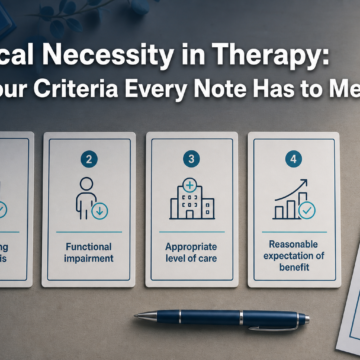
Medical necessity in therapy is the standard your notes have to meet to be reimbursable, and it breaks into four criteria checked at every session. Here is what each one means and how they show up in one real note.
Medical necessity is not established once at intake; every progress note has to re-show it. Here is how to prove medical necessity in a single session: the four criteria note by note, weak-versus-strong language, and a worked example.

A diagnosis says what the client has; functional impairment language says why treatment is necessary. Here is how to write it in observable terms, with weak-versus-strong examples across work, school, relationships, and self-care.

Reasonable expectation of benefit asks for a clinical basis to expect the client will benefit from treatment, not a guaranteed outcome or a score that falls every week. Here is how to document it at intake, over time, and through a plateau.

A behavioral health insurance audit is a documentation review, not a verdict on your clinical skill. Here is what an audit checks, how to respond when a records request arrives, what to send and hold back, and how a routine self-audit keeps you ready.
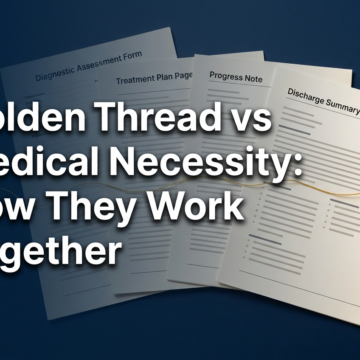
The golden thread and medical necessity get treated as one idea, but they are two. The golden thread is the structure of your clinical argument; medical necessity is the standard that argument has to meet. Here is how they differ and why a defensible chart needs both.
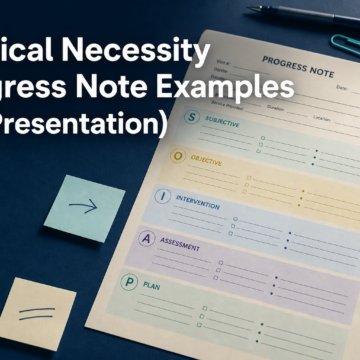
Definitions only go so far. These worked medical necessity progress note examples (anxiety, depression, PTSD, co-occurring, and the improving client) each show the four criteria in a real note, with weak-versus-strong language you can adapt.

A clinical documentation audit you run on your own charts catches gaps before a payer does. This walks through reading a chart in two directions, the focus questions for each document, and the gaps worth looking for first.
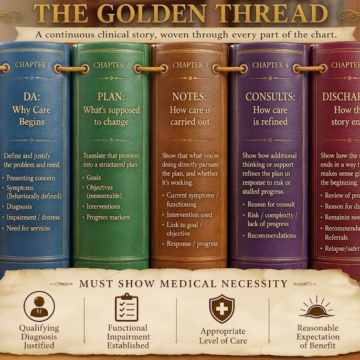
A defensible chart is one connected document. The Golden Thread runs from your diagnostic assessment through your discharge summary, and a reviewer should be able to follow it the whole way. Here is how the four documents link, and how to keep it clear the whole way through.

Documenting start and stop times for therapy sessions is crucial for verifying claims with insurers, preventing clawbacks, and maintaining accurate records. While it may seem redundant, recording clock times ensures compliance with billing codes and supports the integrity of clinical documentation. Developing this practice streamlines the auditing process and protects practitioners' work.