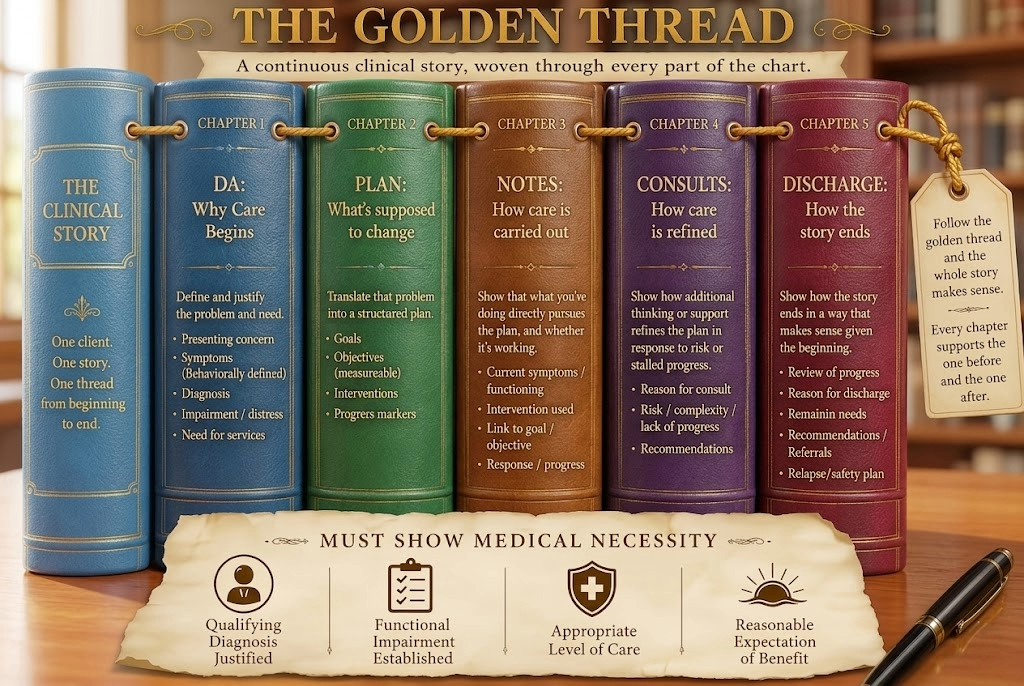
The Golden Thread is the connected logic that runs through a client’s chart from the first session to the last. The diagnosis is established in the intake. The treatment plan turns that diagnosis into goals. The session notes show the work and the client moving. The discharge summary closes the loop. When a reviewer can follow that logic from one document to the next, you have Golden Thread documentation. When they can’t, you have a stack of separate notes.
This matters whether you bill insurance or work entirely private pay (more on that below). If you keep a chart, the thread is what holds it together.
What Golden Thread documentation actually means
A defensible chart reads as one connected document. Each part points back to the one before it: the goals to the diagnosis, the interventions to the goals, every session note to an active goal it shows progress against, and the discharge summary to the whole arc.
Two ideas often get blurred here. The Golden Thread is the structure of your clinical argument, the documented logic a reviewer follows. Medical necessity is the standard that argument has to meet for reimbursement. A chart can be well organized and still fail to show medical necessity, or hold the right clinical reasoning and stay vulnerable because a reviewer can’t trace it. The thread makes your reasoning visible. The content is what has to satisfy the standard.
The four documents, in the order the chart is built
The series I teach with Renee Devine, MS, LMHC follows one client (Marcus, a software developer with generalized anxiety) through all four documents, in the order a real chart comes together.
The Diagnostic Assessment establishes the thread. It identifies the presenting problem, the diagnosis, and the functional impairment (how symptoms interfere with work, sleep, or relationships), and it explains why care is warranted. Everything downstream points back here.
The Treatment Plan operationalizes it. The diagnosis becomes goals, objectives, and interventions you can measure later. A goal like “reduce excessive worry to the mild range within six months, as measured by the GAD-7” gives every future session note something concrete to connect to. (If writing measurable behavioral definitions is where you stall, the free Behavioral Definition Builder at bdb.therapistresources.com handles that part for you.)
The SOAP note demonstrates it. Each session note should connect to an active goal and show movement. It is easy to lose the Golden Thread here. Marcus has a plan goal about getting his worry to a manageable level. Three weeks in, the note reads, “Client engaged well. Processed work stressors. Will continue weekly.” That note does not connect back to the goal or show whether the worry is changing.
The Discharge Summary closes it. It reports outcomes goal by goal, the client’s status at the end, the reason for discharge, and any follow-up. The chart now tells the whole story from intake to last session.
Where the thread breaks, and why it costs you
When the thread breaks, it gets expensive. Renee has lived it. She once faced a $630,000 clawback demand, and what followed was more than a year of attorneys, investigators, and every note pre-approved before it could be submitted.
So the goal is audit-ready documentation. Help your future self out by making the Golden Thread explicit, so every note connects to an active goal and shows movement. The easier you make it for the auditor, the easier you pass.
Who this is for
For a solo clinician, Golden Thread documentation is mostly peace of mind: if a chart ever gets pulled, the story holds together. For a practice owner or clinical supervisor, it works as training-in-a-box. Instead of teaching documentation one new hire at a time, you hand your team one standard for how to produce audit-ready documentation.
Some of this transfers across settings and some of it won’t. The examples are written for outpatient private practice, so if you work inpatient or in community mental health, the principles apply but the specifics won’t all map. It’s up to you to take what fits.
Where to start
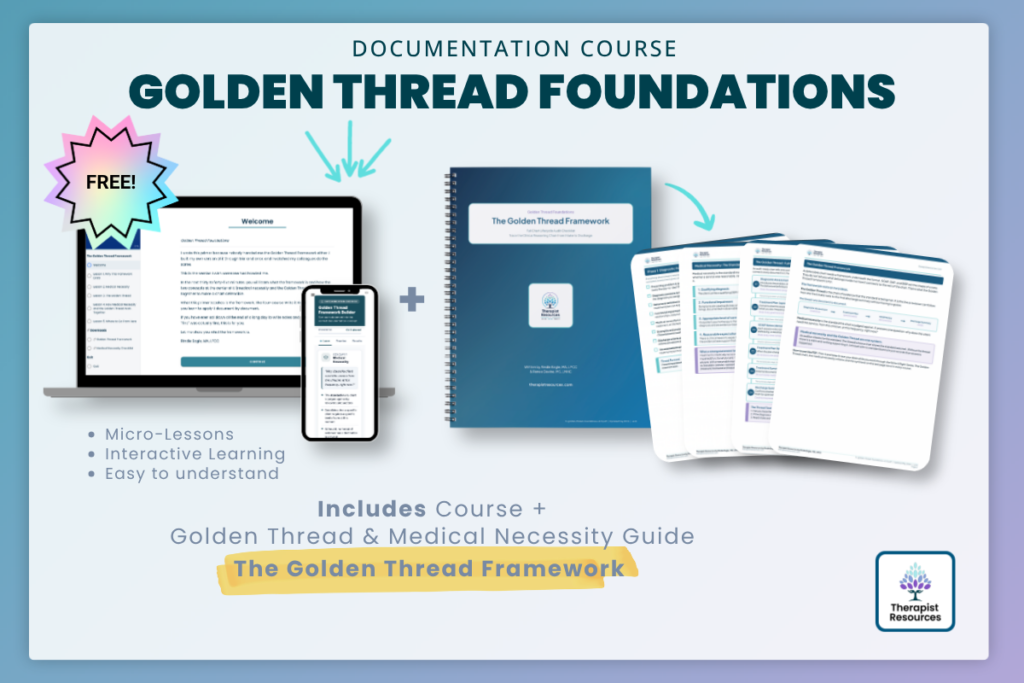
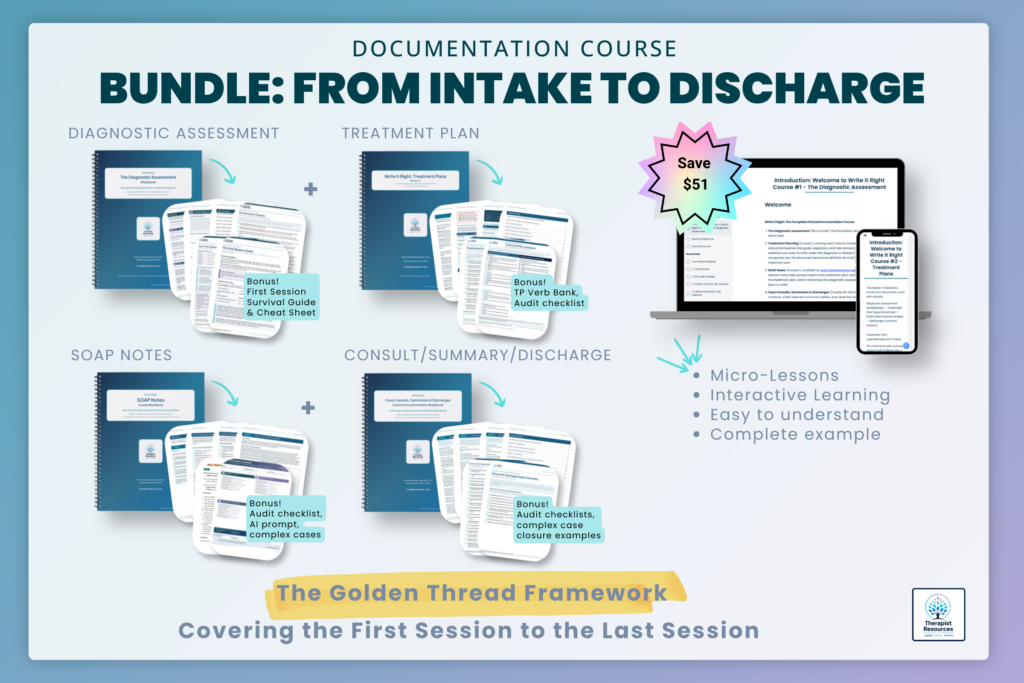
The Write it Right series teaches the four documents in the order the chart is built, with one client running through all of them so you can see the thread connect end to end. If you want the concept first, the free primer at foundations.therapistresources.com covers the Golden Thread before you commit to anything. When you’re ready for the full series, all four courses are in the bundle for $97 (they run $148 bought separately, so you save $51) at goldenthread.therapistresources.com.
Frequently Asked Questions
What is the Golden Thread in clinical documentation?
The Golden Thread is the connected logic that runs through a client’s chart, linking the diagnosis, treatment plan, session notes, and discharge summary so they tell one continuous story. When a reviewer can follow it end to end, the chart shows why care was needed and what it accomplished.
What are the four documents in the Golden Thread?
The diagnostic assessment (establishes the problem and diagnosis), the treatment plan (turns the diagnosis into measurable goals and interventions), the session notes (show each session connecting to a goal and the client moving), and the discharge summary (closes the chart with outcomes and status).
Does the Golden Thread prove medical necessity?
Not on its own. The Golden Thread is the structure that makes your reasoning easy to follow. Medical necessity is the standard your content has to meet for reimbursement: a qualifying diagnosis, functional impairment, an appropriate level of care, and a reasonable expectation of benefit. A strong thread makes that reasoning visible; the content is what satisfies the standard.
What do auditors do when the Golden Thread is broken?
Gaps in the logic can lead to denials or clawbacks. Making the thread explicit, so each note connects back to an active goal and shows movement, is what keeps the chart defensible.
Do private-pay therapists need the Golden Thread?
Yes. Private pay removes the insurance reviewer, but board complaints, subpoenas, records requests, and the next clinician on the case all remain. A connected chart protects you and your client in those situations, payer or no payer.
Discover more from The Happy Brain Universe
Subscribe to get the latest posts sent to your email.
Leave a Reply