I’ve been a therapist long enough to know that documentation is clinical care. I knew the notes mattered. When an insurance audit for therapists arrived by fax at our practice, I found out exactly how much space there was between knowing that and having systems that proved it.
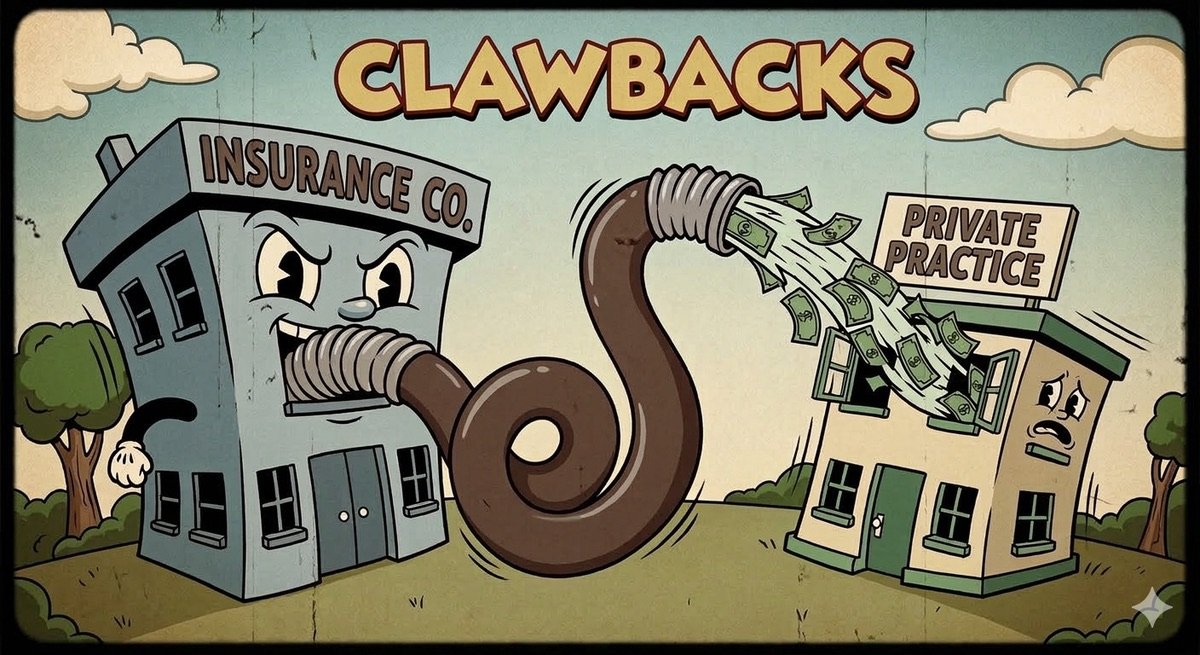
The $630,000 Clawback Demand
Written by blog guest author Renee Divine, MA, LMHC
Our focus had been clinical work. Clinicians were documenting. Claims were going through. Nobody had flagged anything. The documentation layer running underneath all of it had accumulated gaps we didn’t see until someone else started looking.
The Demand
Thirty medical records requested. Thirty dates of service. Thirty clients. The kind of request that gets handled, filed away, and moved on from.
The audit notice gave vague guidance about what “medical records” meant in the context of the request. We made our best interpretation, submitted what we believed was appropriate, and waited.
We failed.
The insurance company gave us 45 days to provide $630,000 or file an appeal. Our practice had approximately 20 clinicians. That dollar amount would have ended it.
Six hundred thirty thousand dollars. Forty-five days. Before I move past that, I want to let it land.
The Legal Search
Attorneys who specialize in insurance audit defense for mental health practices are not easy to find. We were passed from firm to firm before landing at one of the largest in our state. Even those attorneys were puzzled by portions of the audit request’s language.
We appealed. We submitted additional documentation and written responses for every error in our records. What that process revealed was that our failure came down to one thing: documentation gaps. Errors and omissions that had built up quietly across our notes over time. The kind that accumulate when consistent documentation standards are not being enforced session by session.
The clinical work was happening. What a therapy practice audit required (documentation that proved it) was not consistently there.
The SIU
Ninety days after our appeal, we were placed on a Special Investigative Unit (SIU) audit.
If you haven’t encountered this term, a Special Investigative Unit is the insurance company’s mechanism for detecting and investigating fraudulent claims, waste, and abuse. Placement on SIU meant that every single session billed to this company required us to submit clinical documentation for review before they would release payment. Six months minimum. If we failed the evaluation at six months, the therapy practice audit review would continue indefinitely.
The day-to-day looked like this: review the note, confirm the documentation meets standard, upload it to the third-party platform the insurance company uses, wait for approval or denial, respond to any denials with a written appeal. All of this before receiving payment for the session.
That ran alongside everything else the practice was doing.
More Than a Year Later
We passed. More than a year after that first fax, the insurance audit for therapists that had started with 30 records and escalated into SIU review was over.
The audit had been about documentation — whether our notes demonstrated medical necessity, aligned with treatment plans, and met the standard required for reimbursement. We eventually showed that they did. Showing it after the fact required a year of administrative time, legal fees, and disruption I won’t fully describe here.
The simpler version: audit-ready SOAP notes from the start would have meant submitting 30 records and moving on. The documentation gaps that created the problem were fixable. They just needed to be fixed before the fax arrived, not because of it.
What Insurance Auditors Are Actually Looking For
I can tell you specifically what the insurance company scrutinized in our records.
Whether the note reflected the treatment plan. Auditors read session notes alongside the corresponding treatment plan. When a session’s documentation doesn’t clearly connect to an identified treatment goal, that’s a gap they will find and flag.
Whether medical necessity was documented explicitly. Medical necessity documentation means stating specifically why the session was clinically necessary. Describing what happened in a session meets a different standard. Auditors look for the explicit statement, not the implied one.
Whether the diagnosis was specific and reflected in the clinical record. The diagnosis needs to connect visibly to the client’s presenting symptoms. Vague diagnoses or diagnoses without supporting documentation create vulnerabilities in any therapy practice audit.
Whether notes were complete and submitted on time. Incomplete sections and late documentation signal that consistent standards don’t exist across the practice. Auditors read patterns across a file, not just individual notes.
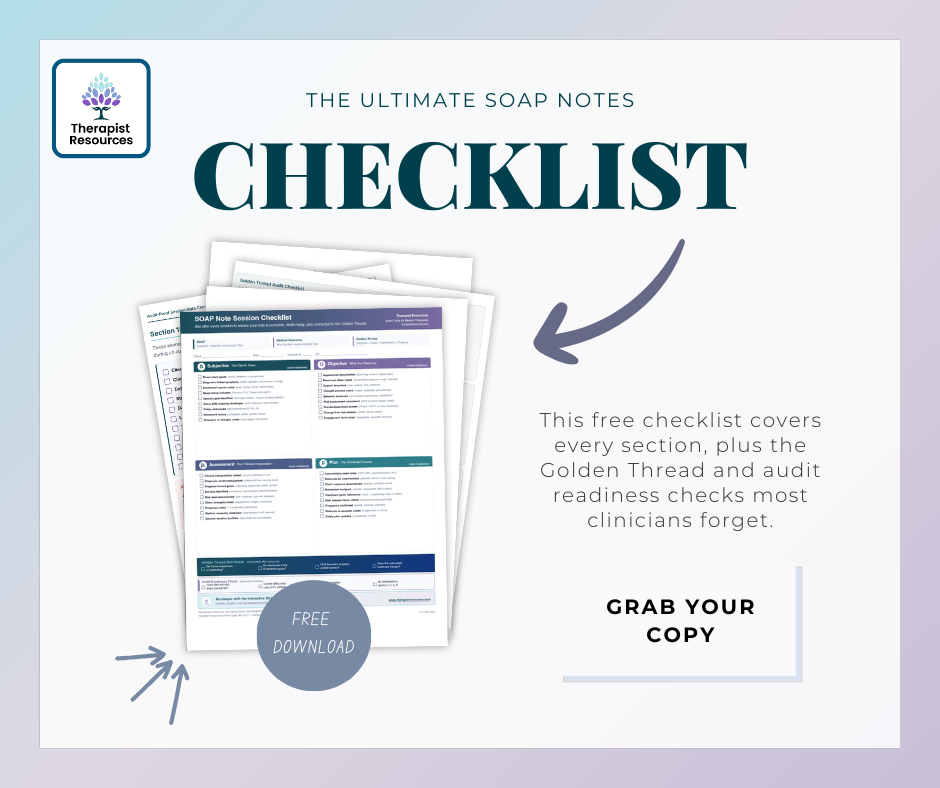
Whether the administrative details were complete. This is where claims get denied before a reviewer ever reaches the clinical content. Auditors check start and stop times, date of service, service location, and clinician signature with credentials on every note. For telehealth sessions, the requirements expand: the platform used, client consent to telehealth services, and the location of both the client and clinician at the time of the session. A missing signature or unspecified service location gives auditors reason to deny the claim before they read a single clinical word. Download the free SOAP Notes Session Checklist for the complete list.
Whether the clinical story made sense across sessions. A reviewer reading several notes in sequence should be able to see where the client started, what has changed, and why the current level of care is appropriate. When that story is not visible, auditors question it.
The SOAP format organizes exactly this information. Documentation that passes an insurance audit for therapists is thorough, specific SOAP documentation done consistently. Not a different kind of clinical thinking. The clinical thinking you are already doing, written in a way that proves it.
Building Audit-Ready SOAP Notes Before the Fax Arrives
The documentation standard required to survive a therapy practice audit is the same standard that creates clinically coherent, defensible records. When your notes clearly document medical necessity, align with the treatment plan, and tell a consistent clinical story across sessions, they do several things at once: they are useful for the client, useful in supervision, and audit-ready.
Start by reviewing one week of your own notes. Can you trace the clinical story across those sessions? Does each note connect to the treatment plan? Would an outside reviewer understand why each session was clinically necessary?
Audit-ready SOAP notes share a few consistent characteristics: medical necessity is explicit, not implied. The diagnosis connects visibly to the presenting symptoms. The session’s intervention ties clearly to a treatment goal. Progress is described in observable terms. Administrative details are complete every time.
If you want a structured framework, the free SOAP Notes Session Checklist covers the elements auditors check, in the order they check them. Use it on your current notes. The gaps, if they exist, will show up quickly.
For a more complete framework, the SOAP Notes Training Course covers the progress notes portion, including how to document medical necessity, how to maintain the thread between notes and treatment goals, and how to build these habits consistently across a practice.
The story has a useful ending. We passed. We learned what a therapy practice audit actually measures. We built better documentation systems because of it. The audit-ready SOAP notes standard our practice uses now is not complicated. It is consistent. And consistent documentation from the start is what turns an insurance audit for therapists from a year-long disruption into a manageable process.
Renee Divine, MA, LMHC is a licensed mental health counselor and co-creator of the SOAP Notes Training Course alongside Rindie Eagle, MA, LPCC of Therapist Resources.
Resources
SOAP Notes Session Checklist
Free session checklist

SOAP Notes Training Course
Learn to write audit-ready SOAP notes
Leave a Reply