
Efficient therapy documentation and audit-defensible documentation require the same four elements. That sentence usually surprises clinicians who have spent years treating speed and thoroughness as competing goals, but the underlying logic is straightforward. A note built around the four elements auditors check takes about three to five minutes to write. A note built around reconstructing what happened in the session can take thirty minutes and still get flagged.
The reason charting takes so long for many clinicians has nothing to do with thoroughness. It is a structural mismatch. Graduate programs teach clinicians to document what happened in the session. Auditors read notes asking a different question entirely: does this note prove why this person needs this specific treatment at this specific frequency right now? These two questions produce different answers, and the second one is actually faster to write once the structure is clear.
This post connects to what the earlier posts in this series have covered: the golden thread, medical necessity, and SOAP fundamentals. Those concepts establish what auditors check. This post shows how to document those elements efficiently, in a structure that becomes automatic within a few weeks of practice.
Efficient Therapy Documentation and Audit-Defensible Notes Are the Same Goal
The documentation time problem is a structure problem. The notes I review in supervision that take the longest to write share one pattern: the clinician is solving the mismatch between what they were trained to document and what an auditor needs to see by writing more. Longer narratives, more detail, more context. The assumption is that quantity equals defensibility. The elements auditors actually check are specific and finite: diagnosis in context, measurable evidence, treatment rationale, and frequency justification. A note that contains those four elements in the right structure takes three minutes. A note that lacks them can take thirty minutes and still leave an auditor without what they need to approve the claim.
The shift is recognizing that the four elements required for audit defensibility are the same elements that make documentation clinically useful. Symptom frequency. Measurable change. A rationale connecting the intervention to the clinical picture. A justification for the current level of care. When the note structure captures those four pieces, it is both fast and defensible. The structure does the work.
The 3-Minute SOAP Framework: A Therapy Note Template Section by Section
A therapy note template built around audit-required elements turns documentation from a reconstruction task into a fill-in-the-structure task. Each section below includes a formula, a hypothetical example, and a note on what that section accomplishes for audit purposes.
Subjective (30 to 45 seconds)
Formula: [Symptom] occurring [frequency]. Functional impact: [specific area]. Severity: [current rating] (was [baseline] at [comparison point]).
The following example is hypothetical and created for illustration purposes only.
Worry about work performance occurring six to eight times daily. Functional impact: two missed work deadlines this month; difficulty concentrating in afternoon hours. Severity: 7 out of 10 (was 10 out of 10 two weeks ago).
Audit purpose: This section establishes symptom specificity, severity, and functional impairment in two sentences. An auditor can verify clinical significance and track change across sessions.
Objective (30 to 45 seconds)
Formula: [Scale score and trend]. Observable: [specific behavioral or physical observation]. Behavior: [homework status, attendance, session engagement].
The following example is hypothetical and created for illustration purposes only.
GAD-7: 14, down from 19 at intake. Client presented with appropriate affect and good eye contact. Arrived on time; completed four days of thought record entries.
Audit purpose: This section provides measurable, verifiable data. The scale score creates a trend an auditor can follow across notes. The observable and behavioral data corroborate the self-report in the Subjective section.
Assessment (45 to 60 seconds)
Formula: Client meets criteria for [diagnosis]. Progress: [measurable change]. Rationale: [this intervention] addresses [this mechanism]. Justification: [why continued care at this frequency].
The following example is hypothetical and created for illustration purposes only.
Client continues to meet criteria for Generalized Anxiety Disorder, moderate severity. Progress: worry frequency decreased from ten to twelve daily to six to eight over four sessions; GAD-7 improved 19 to 14. Rationale: cognitive restructuring targets the rumination pattern maintaining anxiety symptoms. Justification: functional impairment in work concentration persists; continued weekly therapy is medically necessary.
Audit purpose: This is the section that carries the most weight. It connects diagnosis to progress, progress to intervention, and intervention to continued care justification. Every element an auditor checks converges here.
Plan (45 to 60 seconds)
Formula: Continue [frequency] [modality] targeting [symptom or mechanism]. Next session: [specific intervention]. Goal: [measurable outcome] by [timeframe]. Reassess: [when and what triggers a change].
The following example is hypothetical and created for illustration purposes only.
Continue weekly CBT targeting cognitive patterns maintaining anxiety. Next session: introduce behavioral activation targeting work avoidance. Goal: reduce worry episodes to two to three daily within four sessions. Reassess after four sessions to determine whether functional gains support step-down to biweekly.
Audit purpose: This section tells the auditor exactly what happens next, what the measurable target is, and when the clinician will re-evaluate the frequency. Specificity here prevents the most common Plan section gap: “continue weekly therapy” without a reason.
This is a therapy note template that covers every audit-required element. The formulas are consistent across diagnoses and modalities. What changes is the clinical content within each section.
Three Documentation Habits That Make This Sustainable
The framework provides the structure. These three habits make it sustainable across a full caseload.
The notes I see that take the longest are written entirely from memory at the end of the day. A session reference guide visible during or immediately after the session changes this equation. Symptom frequency, functional impact, homework results. By 5 p.m., these are reconstructed rather than remembered, and reconstruction takes time while producing vague documentation. A brief reference guide captures the data at the moment it exists. The note at the end of the day then becomes structure-filling rather than memory-reconstructing. The difference in documentation time is significant, and the difference in documentation quality is even more significant.
Two minutes immediately after a session is worth twenty minutes at the end of the day. The structure is already in place (the template). The data is fresh. The full note gets written in two to three minutes rather than reconstructed in twenty. This one habit shifts efficient therapy documentation from a goal to a daily reality for most clinicians who adopt it. The investment is small. The return compounds across every session.
Free-form writing on a blank EHR field is where most documentation time goes. When the four sections are pre-populated with formula prompts, the clinician fills in clinical data rather than inventing structure from scratch. An EHR therapy note template with the formula already written cuts documentation time significantly. The clinical thinking is the same. The documentation act becomes faster because the structure is already present. For clinicians working with EHR systems that support custom templates, building the formula into the note template is a one-time setup with permanent time savings.
Four Elements That Stay in Every Note When Moving Fast
Every note, regardless of how efficiently it is written, needs to contain four elements for an auditor to approve the claim.
- Symptom specificity. Frequency, duration, or functional impact. “Client reports anxiety” gives an auditor nothing to evaluate. “Anxiety occurring six to eight times daily with functional impairment in work concentration” gives them the clinical picture and the severity context they need.
- At least one measurable indicator. A standardized scale score, a behavioral count, a severity rating compared to baseline. Something an auditor can verify or track across sessions. The specific measure matters less than using one consistently.
- Clinical rationale. One sentence connecting the treatment choice to the clinical picture. Why this intervention addresses this diagnosis for this person. An auditor reviewing the note should be able to follow the logic from diagnosis to treatment without guessing.
- Frequency justification. Why this frequency of care, and why a lower frequency would be clinically inappropriate. “Continue weekly therapy” without a clinical reason leaves the auditor making assumptions about whether the frequency matches the severity.
These four elements are built into the 3-minute framework. Write the note in the structure and they are present automatically. The structure is the protection. Efficient therapy documentation and defensible documentation converge at this point: both require the same four elements, and both benefit from a consistent structure that makes those elements easy to capture.
Frequently Asked Questions
What if a session is clinically complex, involving a crisis, major disclosure, or acute safety concerns?
Complex sessions require more documentation, and that is appropriate. The framework saves time on routine sessions, which represent the majority of a caseload. A complex session naturally expands the Assessment section to two to three minutes. Risk management and safety planning add a brief additional section. The total is still under ten minutes, and the structure keeps the documentation clear even when the clinical content is serious. The efficiency gains from the 3-minute framework on routine sessions are what create the time and mental energy for complex sessions to receive the documentation they require.
Does this framework work the same way for EMDR, DBT, psychodynamic, or other modalities beyond CBT?
Yes. The section structure is identical across modalities. What changes is the intervention language in the Rationale sentence. For EMDR: “EMDR processes traumatic memory and reduces nervous system reactivity; client reprocessed two additional images from the incident and reported decreased emotional intensity during processing.” For DBT: “Distress tolerance skill (ice dive) targets urge to self-harm; client practiced during a crisis earlier in the week and reported urge severity reduced from 8 out of 10 to 4 out of 10.” Same SOAP structure, different intervention specificity. The four audit-required elements remain the same regardless of therapeutic orientation.
What if the EHR makes structured templates difficult?
Many clinicians work with EHR systems that force free-form narrative fields. In those situations, the formula can be written out in a document or reference card and pasted or transcribed into the EHR. The structure is the same regardless of the tool. If an EHR genuinely prevents efficient documentation, that is a practice management issue worth addressing over time. It affects both billing efficiency and audit defensibility. Some clinicians keep the formula printed next to their workstation and transcribe the structure into the narrative field. The added step takes a few seconds and preserves the documentation gains.
Putting the Structure Into Practice
The shift this post describes is a documentation habit built on structure. The clinical reasoning is already happening in every session. Audit-ready therapy notes make that reasoning visible in the written record in the same way it is already visible in the clinical work. The four elements auditors check are the same elements that define good clinical documentation. The structure that supports one supports the other.
Clinicians who adopt the 3-minute framework consistently report the same thing: notes feel more coherent because the structure forces explicit reasoning, and the habit becomes automatic within a few weeks. The investment in learning the structure returns in time saved across every note written thereafter.
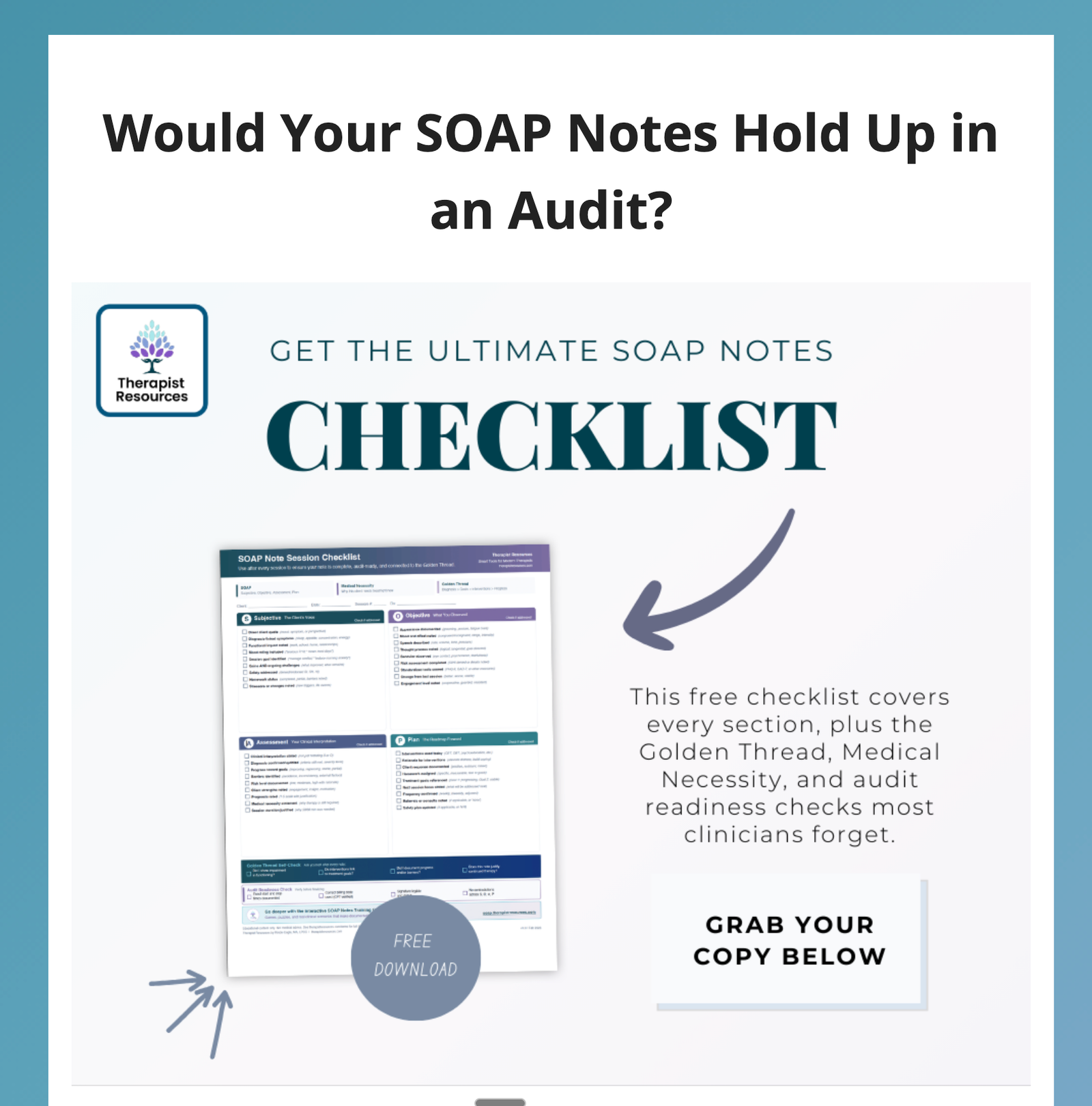
The free SOAP Notes Session Checklist provides a section-by-section prompt structure built around all four audit-required elements. Use it for one week of notes and the efficiency and defensibility gains will be visible. The SOAP Notes Training Course covers the complete documentation framework with templates, examples, and structure adaptable to any practice and supervision workflow.
Rindie Eagle, MA, LPCC is a licensed professional clinical counselor, clinical supervisor, and co-creator of the SOAP Notes Training Course alongside Renee Divine, MA, LMHC.
Discover more from The Happy Brain Universe
Subscribe to get the latest posts sent to your email.
Leave a Reply