Perfectionism Is Not Making You Better at Your Work
The cultural script is that perfectionists are your best employees. The high achievers. The ones who care so much they stay late.
The research does not agree.
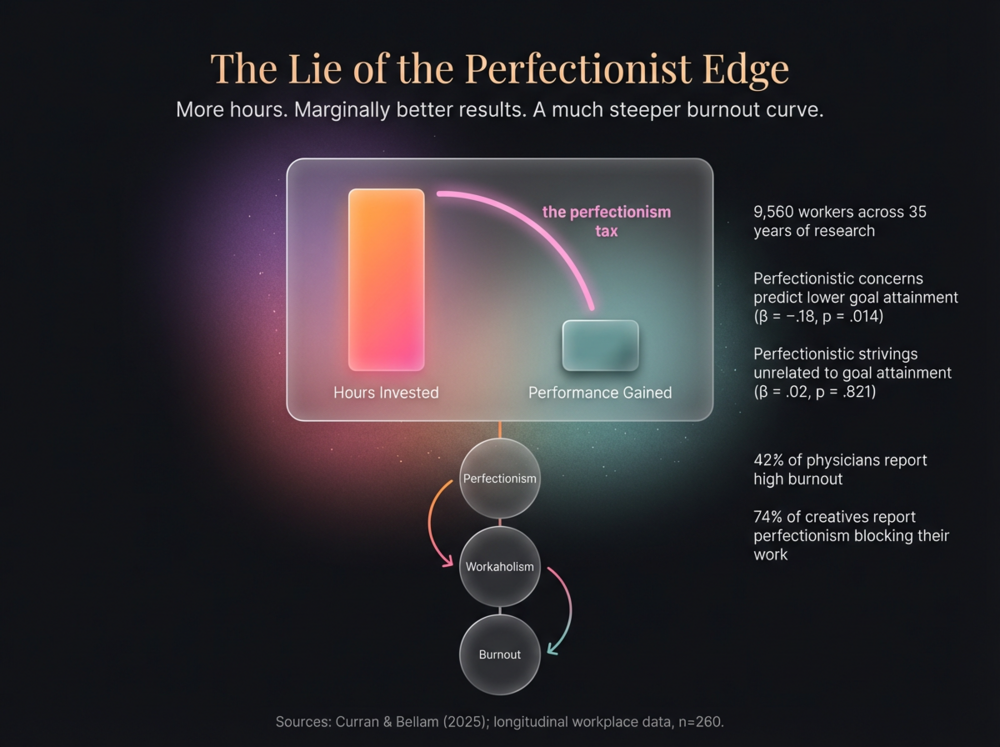
A 2025 meta-analysis by Thomas Curran and Aishwarya Bellam looked at data from 9,560 participants across 35 years of workplace research. They wanted to answer one question clearly: does perfectionism improve performance?
Two findings:
- Both types of perfectionism are linked to longer working hours. Perfectionists genuinely do work more.
- The actual performance benefit is marginal. Especially in proportion to the time invested.
This is the quiet joke of achievement culture. The people working the hardest toward “perfect” are not pulling much more output than the people next to them. They are pulling more hours.
The perfectionism tax
There is a tidy way to visualize this. On one side, a tall bar representing hours invested. On the other side, a short bar representing performance gained. The gap between them is what the tax of perfectionism actually costs you.
A 2025 longitudinal study of 260 employees (published in European Journal of Work and Organizational Psychology) tightened the picture with structural equation modeling:
- Perfectionistic strivings (high standards) at Time 1 were not related to work goal attainment at Time 2 (β = .02, p = .821).
- Perfectionistic concerns (fear of imperfection) at Time 1 were negatively related to work goal attainment (β = -.18, p = .014).
Read that second line carefully. The people most afraid of making mistakes were less likely to hit their goals six months later. The fear is not a performance engine. It is a drag on the engine.
The burnout output
Perfectionism’s real output is not excellence. It is burnout.
In a sample of physicians, 42% reported high emotional exhaustion or depersonalization burnout, and self-critical perfectionism uniquely predicted both outcomes. A 2024 study covered by Taylor & Francis found perfectionists significantly more susceptible to burnout as a function of personality, because “they set unrealistic and unrelenting standards for their own performance, which are ultimately impossible to live up to.”
The mechanism is well documented. Perfectionism leads to workaholism. Workaholism leads to burnout (Schaufeli et al.). The chain is consistent across studies.
Even parents are not spared. A recent Ohio State study found that 57% of parents reported parental burnout, with perceived external expectations (a proxy for socially prescribed perfectionism) as the strongest driver.
What about creativity?
This is where the research gets grim.
A 2025 study in Frontiers in Psychology (PMC11850400) found that perfectionism was negatively associated with both originality and fluency in divergent thinking tasks. The mechanism: concerns about mistakes suppress the flexible, exploratory thinking that generates original ideas.
Separate regression analysis found a strong relationship between perfectionism and creativity (R² = .42). Adaptive perfectionism predicted creativity positively (β = .40). Maladaptive perfectionism predicted it negatively (journal PDF).
Among working creatives specifically, 74% report perfectionism-related behaviors (overworking, procrastination, and fear of sharing work) that block their development.
So the story looks like this. Maladaptive perfectionism gives you more hours, marginal output, higher burnout risk, and lower creative capacity. The deal is bad in every direction.
The brain science footnote
fMRI research (NICABM summary) found a real divide between two types of perfectionists.
People high in Personal Standard Perfectionism show strong activity in the anterior cingulate cortex (the brain’s error-processing region) after a mistake. Their brains slow down, register the error, and use it to learn. This is adaptive.
People high in Evaluative Concern Perfectionism show weaker error management. Their brains are busy fearing judgment, not correcting course.
Same mistake. Two completely different internal responses. One uses the error for information. The other uses it for self-attack.
The Adlerian read
Alfred Adler talked about the “useless side of life.” He meant the behaviors we run that make us look safe but keep us stuck. Perfectionism at work is usually a useless-side move dressed up as a virtue.
It is a strategy for controlling how others see you. For never getting caught in an inadequate moment. For avoiding the vulnerability of being a learner in public.
It served a purpose. At some point in your life, it kept you safer. The problem is that the strategy keeps running long after the context that built it is gone, and now it costs you hours, output, sleep, and the energy you need for actual creative work.
What to do instead
You do not fix this by lowering your standards. Adaptive perfectionism, the flexible kind, is real and it works. The issue is the fear-based version.
A few things the research supports:
- Target the fear, not the standards. Cognitive-behavioral therapy (CBT) produces a large effect size on perfectionism (η² = 0.78) when it targets concern over mistakes rather than trying to lower ambition (PMC12138642). Internet-delivered CBT reduces both strivings and concerns, often without even focusing on perfectionism directly (PubMed).
- Interrupt the hours-without-output loop. Time box hard. Ship the draft. Notice whether the extra two hours actually made the output better or just quieter in your head.
- Practice being a visible learner. Share work in progress. Ask a dumb question on purpose. Let a colleague see your second-best draft. The courage move here is not lowered standards. It is a lowered defense.
The one sentence version
Movement creates clarity. Polishing creates exhaustion.
Ship the work. Track the result. Let the evidence do what the fear has been refusing to let it do.
Discover more from The Happy Brain Universe
Subscribe to get the latest posts sent to your email.
Leave a Reply