Perfectionism Is Rising: What 30 Years of Data Say About Why We Feel So Awful
Perfectionism is the trait people still brag about in job interviews. It sounds like a weakness that is secretly a strength. The data say something different.
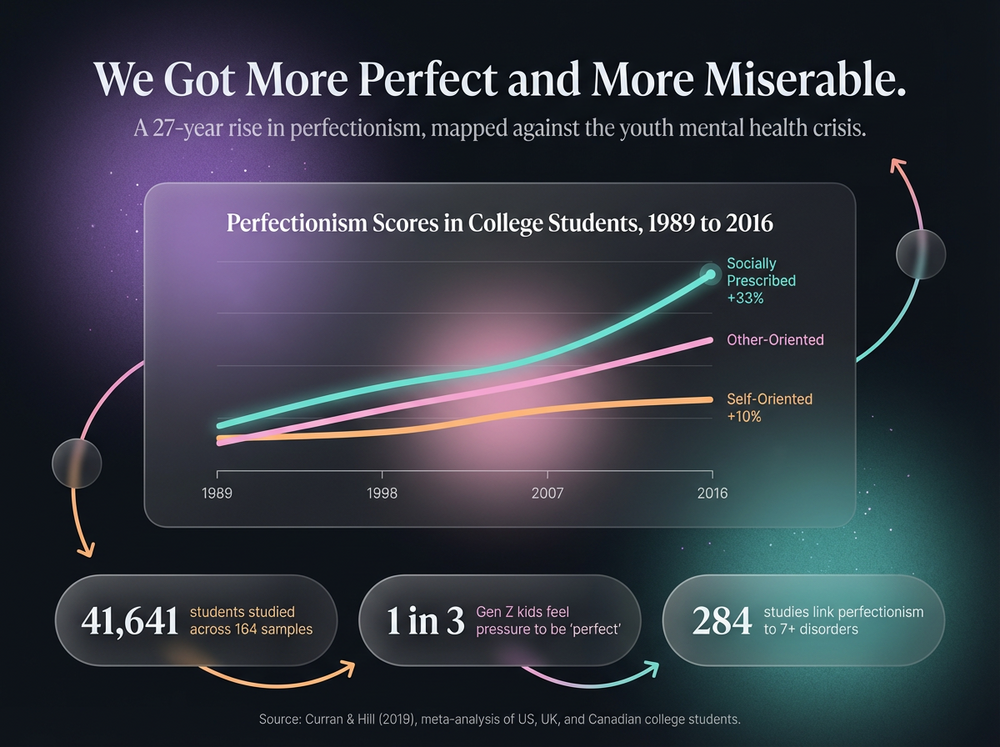
Between 1989 and 2016, psychologists Thomas Curran and Andrew Hill pulled together 164 samples of American, British, and Canadian college students. That is 41,641 young people over 27 years, all scoring themselves on the same perfectionism measure. They published the results in a 2019 meta-analysis in Psychological Bulletin (PubMed).
What they found is the clearest picture we have of perfectionism increasing across a generation.
The three kinds of perfectionism
Before looking at the numbers, it helps to know that perfectionism is not one thing. Researchers separate it into three:
- Self-oriented perfectionism. The drive you put on yourself. Your own impossibly high standards.
- Socially prescribed perfectionism. The belief that other people require you to be perfect. The pressure feels like it is coming at you from outside.
- Other-oriented perfectionism. Holding everyone around you to standards that are not realistic.
Curran and Hill measured all three over 27 years. The results did not move evenly.
The 27-year numbers
| Type of perfectionism | Change from 1989 to 2016 |
|---|---|
| Self-oriented | +10% |
| Other-oriented | Significant linear increase |
| Socially prescribed | +33% |
Source: Curran, T., & Hill, A. P. (2019). Perfectionism is increasing over time: A meta-analysis of birth cohort differences from 1989 to 2016. Psychological Bulletin, 145(4), 410-429. PubMed record here.
Self-oriented perfectionism rose 10%. That is not nothing. It means young people are asking more of themselves than their parents did at the same age.
But look at that third row. Socially prescribed perfectionism increased by 33%. Over three times the rise of the self-oriented version. The dominant story young people carry now is not just “I must be perfect.” It is “everyone around me requires that I be perfect, and I am constantly being measured.”
The American Psychological Association covered the finding in a 2018 press release that is still worth reading.
Why this matters for how you feel
Perfectionism is not just a personality quirk. A large 2018 meta-analysis of 284 studies found it at the root of insomnia, depression, anxiety, eating disorders, social phobia, self-harm, and OCD.
Socially prescribed perfectionism is the one most consistently linked to the worst outcomes. It is the variety the research connects to suicidal ideation, disconnection, and the feeling of not mattering (Etherson et al., 2024).
Which means the kind of perfectionism rising fastest is also the kind that hurts most.
The generational data line up. A 2024 survey of 1,600 youth ages 10 to 18 found that 1 in 3 Gen Z kids feel they have to be “perfect.” Girls are 14 percentage points more likely than boys to report that pressure. Among young people ages 16 to 25, 85.4% identify as having perfectionist tendencies of some kind.
Why is this happening?
Curran and Hill point to cultural shifts (their 2022 follow-up paper expands the theory). Competitive individualism. Meritocracy framing. Image performance. A steady rise in anxious, high-expectation parenting as the economic pressure on families grew.
Put plainly: the world these young people grew up in told them, over and over, that they were being watched and graded. Social media became a 24-hour measurement device. Parenting culture got more anxious. School got more competitive. And the number that rose 33% is the belief that everyone is judging you.
That is not a personal failing. That is a pattern forming in response to a context.
The Adlerian read
Alfred Adler would not be surprised by any of this. His whole framework assumed that people develop patterns in response to the environment they are growing up inside of. Patterns are not flaws. They are adaptations that made sense at the time.
Socially prescribed perfectionism is a strategy. It is the strategy of staying safe by staying impressive. It worked in the moment it was learned. In a peer group where visibility felt risky, performing perfectly was a way to not be attacked.
The trouble is that the strategy keeps running after the original context is gone. You are thirty-two years old and the performance is still on. It never gets to turn off because the audience lives in your head now.
One courage-based move
You cannot out-think socially prescribed perfectionism. You cannot reason your way to “other people aren’t really judging me.” The pressure comes from a nervous system that learned to scan for threat and never stopped.
What actually shifts the pattern is movement. Specifically, visible imperfect movement.
Post the thing with a typo in it. Send the email before it is polished. Show up to the meeting without rehearsing your answer. Let someone see a draft.
Every time you do that and the world does not end, your nervous system files away a new data point: “I was visibly imperfect, and I am still here.” This is slow work. It is also the only work that actually moves the needle, because the fear is experiential and the answer has to be experiential too.
In Adlerian language, this is courage. Acting before you feel ready. Letting the clarity come from the movement, not the other way around.
Where to start this week
Pick one thing you have been over-polishing. Send it.
Not the hardest thing. One tier down from the hardest thing. The small, safe experiment that lets you learn, in your body, that visibility is survivable.
You are not going to argue yourself out of a 33% cultural rise. You are going to collect evidence, one small move at a time, that you get to be imperfect and still belong.
That is what the data are actually asking of us. Not more striving. A different relationship with being seen.
Discover more from The Happy Brain Universe
Subscribe to get the latest posts sent to your email.
Leave a Reply