How Instagram Turbo-Charged the Worst Kind of Perfectionism
Not all perfectionism hurts the same.
The research is clear about this. Self-oriented perfectionism (your own high standards) is painful but can sometimes drive useful work. Socially prescribed perfectionism, the belief that other people require you to be perfect, is the one consistently linked to depression, eating disorders, addiction, and suicidal ideation.
And socially prescribed perfectionism is the exact version that social media is built to manufacture.
What the research actually says
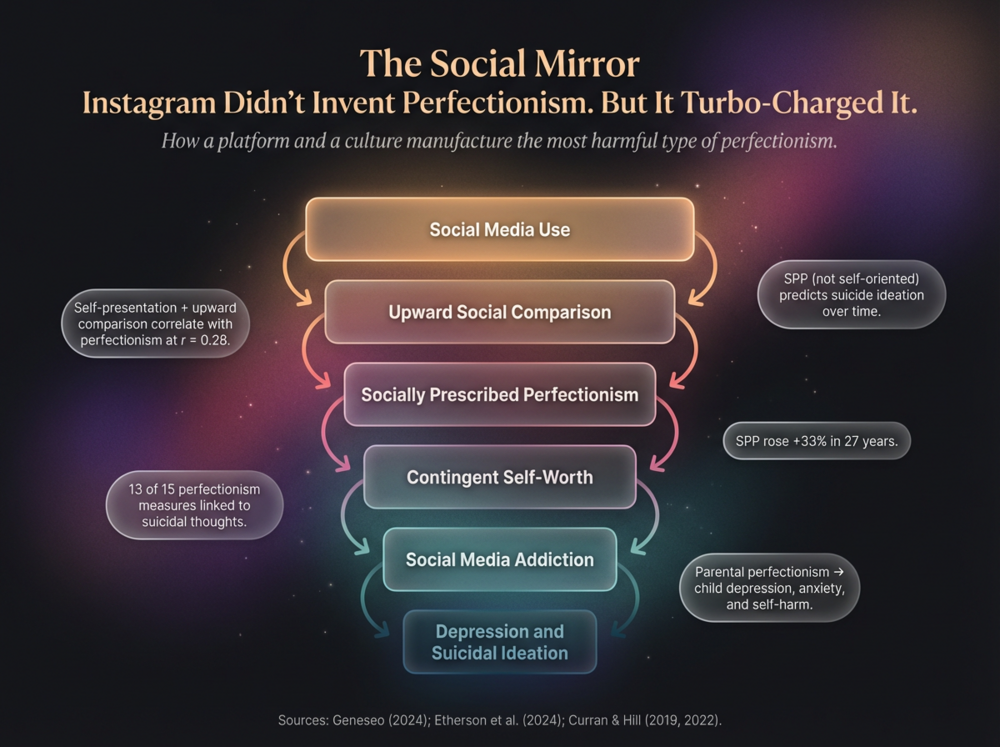
A 2024 study in PMC (PMC11389274) found that focus on self-presentation and upward comparison on social media was positively associated with perfectionism at a standardized coefficient of 0.28. That is a meaningful, consistent effect in behavioral research.
On Instagram specifically, researchers (Hogrefe, 2024) found that “non-display of imperfection,” the practice of filtering every post until no flaws are visible, was the most harmful dimension of perfectionistic self-presentation. It predicted decreased body satisfaction and problematic platform use in young women over time.
Research out of SUNY Geneseo traced the full pathway:
Socially Prescribed Perfectionism → Contingent Self-Worth → Social Media Addiction → Depression.
The team found that people high in socially prescribed perfectionism are “more apt to scroll media to see beauty standards, influencers, and measures of success, which they may place on their self-worth.” The scrolling feeds the pattern. The pattern feeds the depression.
Why socially prescribed perfectionism is the dangerous one
A comprehensive analysis covered by the British Psychological Society found that 13 of 15 different measures of perfectionism were associated with increased suicidal thoughts. The measures tied to meeting others’ expectations (socially prescribed perfectionism specifically) were additionally associated with higher rates of suicide attempts, not just ideation.
A longitudinal study confirmed the directionality. Socially prescribed perfectionism predicts suicide ideation over time. Self-oriented perfectionism does not.
The proposed mechanism runs through “feelings of not mattering.” When the perceived demands of others are not met, the person feels increasingly worthless and unseen. Your sense of worth is placed in something external, and external things can be withdrawn at any moment.
This is what makes Instagram perfectionism uniquely dangerous. It is not the comparison itself. It is that the entire platform is built to attach your self-worth to the approval of people who are not in the room with you.
The 33% rise, in context
The Curran and Hill meta-analysis found socially prescribed perfectionism rose 33% in college students between 1989 and 2016. That is more than three times the rise of self-oriented perfectionism over the same period.
The timing is not coincidental. That window is almost exactly the rise of social media as a daily experience for young people. Curran and Hill’s 2022 follow-up paper names excessive parental expectations and harsh parental criticism as the most plausible mechanisms, both of which are themselves responses to the same competitive cultural pressure that social media accelerates.
The parenting transmission
This does not only happen online. It also happens at the dinner table.
A 2025 scientific review (Scientific American coverage) confirmed that “perfectionistic parents tend to raise perfectionistic kids, which can increase kids’ risk for depression, anxiety, self-criticism and self-harm.”
An analysis of 14 studies found that parents’ perfectionism about their own parenting can lead children to see mistakes as evidence they are bad people. Modeling unrealistically high expectations fosters low self-esteem and pervasive failure in children. Parental perfectionist expectations and criticisms were both significantly associated with adolescent internet gaming addiction as an escape behavior.
So the loop is a system. Parents under cultural pressure raise kids under cultural pressure, and those kids marinate in a social media environment designed to amplify exactly this pattern. That is not a diagnosis of anyone. It is a map of the terrain.
The Adlerian read
Adler would look at this and say something quieter than you might expect. He would say: this makes sense.
A nervous system growing up in an environment of constant measurement will learn to measure itself constantly. A person whose belonging was once conditional on performance will scan every room, every feed, every interaction, for signs of whether they are still passing.
The pattern is not a personal failing. It is a reasonable adaptation to a measuring environment. The problem is that the adaptation is now running 24 hours a day because the measuring environment never turns off.
What Adler offered was a different anchor for worth. Contribution. Connection. Movement in the direction of something that matters. Not worth tied to approval. Worth tied to participation.
That is the frame that makes the data survivable.
What you can actually do
You are not going to out-discipline an algorithm designed by thousands of engineers to hold your attention. You are also not going to reason your way out of a nervous system that grew up inside of it.
A few things the research does support:
- Notice the scroll-to-worth loop. The Geneseo pathway (SPP → contingent self-worth → addiction → depression) gives you a checklist. When you catch yourself scrolling to find out whether you are okay, that is the loop running. The noticing itself is the first interrupt.
- Re-anchor worth in contribution, not comparison. Adlerian research and practice both support this. Ask: what can I do today that helps one other person, in one small way? That question does not rely on any algorithm to answer.
- Practice visible imperfection. Post the thing without the filter. Share the unpolished draft. Send the voice memo instead of the rewritten paragraph. Every time you do that and remain a person with worth, you give your system a new data point.
- Get help if the pattern is connected to self-harm or suicidal thoughts. The research is clear that socially prescribed perfectionism is a real risk factor. If this is you, 988 (Suicide and Crisis Lifeline) is available by call or text in the US.
The courage move
The Adlerian version of all of this is that worth does not come from being measurable. It comes from being in motion toward something that matters, with and for other people.
Instagram cannot hand that to you. It was not built for that. What it was built for is scale, engagement, and the specific psychological pattern that this research has now traced from comparison to self-worth to addiction to depression.
You get to opt out of the pattern without opting out of your life.
Start with one thing. Post something unfiltered. Reach out to one person privately instead of posting publicly. Do one small act of contribution today that nobody will see.
Clarity comes from the movement. Not from the measurement.
Discover more from The Happy Brain Universe
Subscribe to get the latest posts sent to your email.
Leave a Reply