The Perfectionist’s Secret: They Don’t Start
Perfectionists are supposed to be the over-workers. The ones who grind. The ones who cannot stop polishing a thing.
They are often also the ones who have not started.
This is the quiet paradox that shows up in the research on perfectionism and procrastination. The same person who pulls all-nighters on one project has three unopened documents sitting in their draft folder that have been there for six months.
What the research shows
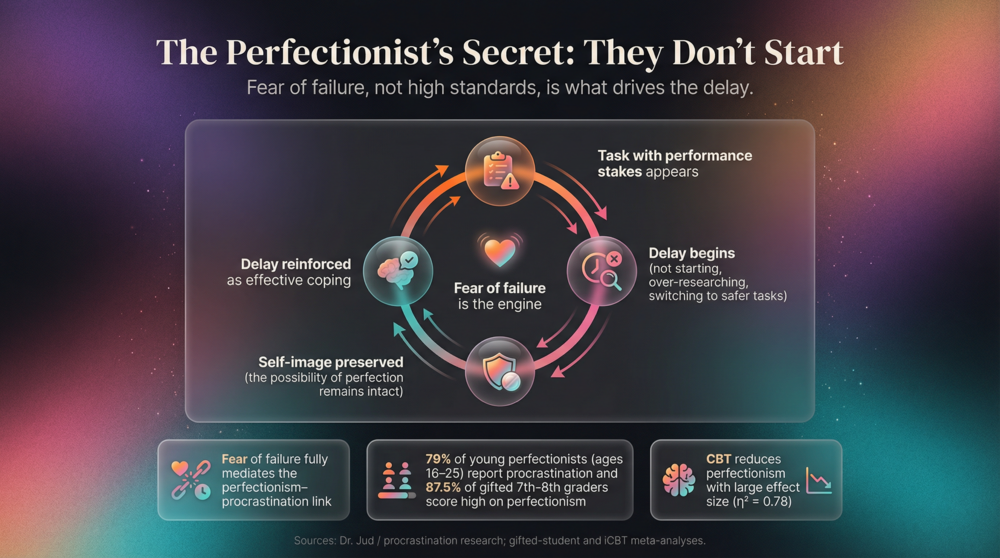
Dr. Jud Brewer and the broader literature converge on a specific finding: fear of failure fully mediates the relationship between perfectionism and procrastination. That is the clinical way of saying that perfectionism on its own does not cause avoidance. Remove the fear and the link dissolves.
Among young people ages 16 to 25 who identify as perfectionists, 79% report procrastination as a common behavior. Among creatives, procrastination is one of the primary ways perfectionism shows up.
This is not a time management problem. It is a fear problem wearing time management clothes.
The psychological logic
Here is what actually happens inside the loop.
As long as you have not started the task, the story “I could do it brilliantly if I really tried” stays intact. Starting destroys that story. Starting turns the brilliant hypothetical version of you into an actual draft that can be judged.
Not starting is the reward. It preserves your self-concept of potential excellence while protecting you from the evidence of imperfection.
The behavioral loop looks like this:
- A task with performance stakes appears.
- Delay begins. Not-starting, over-researching, cleaning the kitchen, working on something safer.
- Self-image stays intact. The possibility of perfection remains available.
- The nervous system files the delay as effective coping. The next time a similar task appears, the pattern runs faster.
Your brain is doing exactly what it was built to do. It found a behavior that reduced discomfort. It is running it back.
The academic data
In academic settings, the procrastination-perfectionism link shows up most clearly in socially prescribed perfectionism. That is the variety where the pressure feels external, where you believe other people require excellence from you.
A University of Maine study found socially prescribed perfectionists demonstrate higher neuroticism in goal-oriented behavior and less confidence navigating complex academic and social scenarios, even when their GPAs look similar to their peers.
Among gifted students, the paradox intensifies. A classic study of 7th and 8th grade gifted students found 87.5% scored high on perfectionism. A 2025 meta-analytic review (Journal for the Education of the Gifted) found gifted students have higher self-oriented perfectionism than typical peers. When they expect perfection from themselves, school stress climbs, and the result is burnout rather than engagement.
High standards are connected to achievement. They are also connected to lower happiness and lower creative output. The research is consistent on both sides.
The trick your brain is running
Procrastination in perfectionists is not laziness. It is a protection racket.
Laziness would mean you did not care. You care too much. The reason you cannot start is because the task is symbolically loaded. If you do it and it is not great, it means something about you. Your worth is attached to the outcome. Your self-image is on the line every time you open the document.
So your brain finds a smart workaround. It arranges for you to never quite open the document. No draft, no evidence. No evidence, no judgment. No judgment, no threat to identity.
This is why “just start” advice does not work on you. The task is not the task. The task is proving you are enough, and you are trying to do that in a form that cannot be undone once it exists.
The Adlerian read
Adler would say the pattern started for a reason. Somewhere back there, your worth got tangled up with your output. Maybe attention was conditional. Maybe mistakes cost you. Maybe excellence was the price of belonging.
Your nervous system learned: the way to stay safe is to perform. And when you cannot perform at the level that feels required, the safer move is to not produce anything measurable.
This is not a character flaw. It is an adaptation that made sense in the environment that built you.
The pattern is now running in an environment that no longer requires it. You can retire it. Not by force, and not by talking yourself out of it. By showing your system, one small action at a time, that the old rule does not apply anymore.
The courage move
The only thing that actually breaks this loop is imperfect action done visibly.
Not “start the hard project.” Too big. Too loaded.
Start a terrible version. Open the document and write one paragraph you are embarrassed by. Send the email with a typo still in it. Ship the draft before it is ready.
What you are doing is giving your nervous system a corrective experience. “I did the imperfect thing. Judgment did not destroy me. My worth is still here.”
Do that enough times and the loop loosens. The task stops being symbolic. It becomes a task.
This is what the CBT data actually show. Cognitive-behavioral therapy produces a large effect size on perfectionism (η² = 0.78) when it targets fear rather than standards (PMC12138642). The cure is not aiming lower. The cure is letting yourself be visibly, survivably imperfect.
What to try this week
Pick one thing you have been avoiding. Not the hardest thing. One tier under it.
Set a timer for 20 minutes. Write or build or send the first terrible version. Do not fix it. Do not polish it.
Notice what your body does when you put it out before it is ready. That reaction is the whole pattern showing itself. That reaction is also exactly what needs the corrective experience.
You do not need to feel ready to start.
You need to start, and let the clarity come from the movement.
Discover more from The Happy Brain Universe
Subscribe to get the latest posts sent to your email.
Leave a Reply