
This post picks up where Part 1 of this series left off. Part 1 walked through what auditors look for in each section of a SOAP note and closed with a full before-and-after note comparison showing the structural differences between documentation that gets flagged and documentation that gets approved. The elements are clear. What remains is how they break down in practice, and SOAP notes training is most useful when it addresses both the patterns that create problems and the structure that prevents them.
This post covers the five documentation patterns that consistently create audit gaps, how SOAP structure connects to the golden thread and medical necessity frameworks, the 3-minute template for writing every section efficiently, and the questions that come up most often in supervision and training.
Five Documentation Patterns That Create Audit Gaps in SOAP Notes
These five patterns appear consistently in the notes I review in supervision. These are documentation habits, not reflections of clinical judgment. Every one of them is correctable with a small structural adjustment.
Subjective without specificity. A Subjective section that reads “client reports feeling anxious and stressed this week” gives an auditor a general sentiment with no clinical data. Symptom frequency, functional impact, and severity rating are the three elements that turn a summary into evidence. The shift is straightforward: instead of “feeling anxious,” document the frequency of anxiety episodes, what daily functioning they affect, and where the client rates severity on a consistent scale compared to baseline. Those three data points take fifteen seconds to capture and make the Subjective section audit-defensible.
Objective as impressions instead of observable data. “Client appeared engaged and mood seemed improved” is a clinical impression. An auditor reading ten consecutive notes that say “appeared engaged” has no trend data and no way to verify any of it. The Objective section needs at least one element that can be independently measured or tracked across sessions. A standardized scale score, a behavioral count, a specific functional indicator (sleep hours, days missed from work, homework completion). The specific tool matters less than using it consistently so an auditor can see whether treatment is producing measurable change.
Assessment with no diagnosis restatement. This is the pattern I see most frequently in supervision. The diagnosis appears at intake. Ten sessions later, the Assessment section reads “client is making progress” with no mention of the diagnosis. Auditors read notes in sequence and cannot assume continuity from the intake form. A one-sentence restatement takes fifteen seconds: “Client continues to meet criteria for [diagnosis] based on [current symptoms].” That sentence closes the gap between intake documentation and the current note.
Assessment that documents progress without frequency justification. This pattern is particularly common in the middle phase of treatment. “Client shows significant improvement in anxiety symptoms and is developing strong coping skills.” To a clinician, this is positive. To an auditor, it raises a question: if the client is improving significantly, why is weekly therapy still necessary? Progress and ongoing clinical need can coexist in the same Assessment, but both have to be written. “Client shows measurable improvement in worry frequency; however, functional impairment in work concentration and sleep persists at a level that warrants continued weekly therapy” documents improvement and justification in the same sentence.
Plan with no clinical rationale for continued frequency. “Continue weekly therapy, work on coping skills” is a plan that answers none of the auditor’s questions. What specific intervention will be used next session? What measurable goal is the treatment working toward? Why weekly instead of biweekly? A complete Plan section names the next intervention, states a measurable target, and includes a clinical reason for the current frequency. Once this structure becomes habit, the Plan section takes under a minute to write and preemptively answers the question that triggers most audit flags.
How SOAP Notes Training Connects to the Full Documentation Framework
SOAP structure sits inside a broader documentation framework. Two concepts covered earlier in this series connect directly to it: the golden thread and medical necessity.
The golden thread is the visible line connecting diagnosis to treatment goals, goals to interventions, interventions to measurable outcomes, and outcomes to treatment justification. The medical necessity framework establishes why treatment at this level of care and frequency is clinically warranted.
A SOAP note with all four sections complete automatically supports both. The Subjective section establishes symptom presence and severity (medical necessity). The Objective section provides measurable evidence of the clinical picture (golden thread connection 3). The Assessment section states the diagnosis, connects it to the treatment approach, and justifies the current frequency (golden thread connections 1, 2, and 4, plus medical necessity). The Plan section carries the treatment forward with specificity.
SOAP note best practices and audit defensibility converge at the same point. A note that follows the SOAP structure with all required elements present is, by design, a note that demonstrates the golden thread and documents medical necessity. These are the same documentation habit expressed through different lenses. SOAP notes training that addresses all three frameworks simultaneously is more efficient than learning each one separately, because the underlying structure is identical.
The SOAP Note Template: A 3-Minute Structure for Every Session
The SOAP note template below covers every audit-required element in approximately three minutes of documentation time. Each section has a formula and a timing estimate based on what clinicians in supervision report once the structure is familiar.
The following examples are hypothetical and created for illustration purposes only.
Subjective (30 to 45 seconds):
Formula: “[Symptom] occurring [frequency]. Impact: [functional area affected]. Severity: [current rating] (was [baseline rating]).”
Example: “Client reports panic attacks occurring two to three times weekly, down from five to six at intake. Impact: avoiding driving on highways and has not driven to work in two weeks. Severity: 7/10 (was 9/10 at intake). States panic episodes are shorter in duration but still disruptive to daily routine.”
Objective (30 to 45 seconds):
Formula: “[Scale score and comparison]. Observable: [specific behavioral or physical observation]. Behavior: [homework completion, attendance, engagement specifics].”
Example: “PHQ-9 score: 12, down from 18 at session one. Client presented with constricted affect and slowed speech rate. No psychomotor retardation observed. Reports sleeping five to six hours nightly, up from three to four hours at intake. Attended appointment on time. Completed behavioral activation homework (identified three activities and completed two).”
Assessment (45 to 60 seconds):
Formula: “Client meets criteria for [diagnosis]. Progress: [measurable change with data]. Rationale: [intervention] addresses [mechanism]. Justification: [why continued care at this frequency].”
Example: “Client continues to meet DSM-5 criteria for Panic Disorder with Agoraphobia. Progress: panic frequency decreased from five to six weekly to two to three weekly over six sessions. PHQ-9 improved from 18 to 12. Rationale: interoceptive exposure targets the catastrophic misinterpretation of physical sensations maintaining panic episodes. Justification: functional impairment in transportation and work attendance persists; weekly frequency remains appropriate given ongoing agoraphobic avoidance.”
Plan (45 to 60 seconds):
Formula: “Continue [frequency] [modality] targeting [symptom or mechanism]. Next: [specific intervention]. Goal: [measurable outcome by timeframe]. Reassess: [when and what triggers change].”
Example: “Continue weekly individual therapy targeting panic symptoms and agoraphobic avoidance. Next session: begin in vivo exposure hierarchy for driving, starting with short local routes. Homework: practice interoceptive exposure (spinning exercise) once daily and log anxiety ratings before and after. Goal: reduce panic episodes to zero to one weekly and resume driving to work within four sessions. Reassess after four sessions; if panic frequency and avoidance decrease, step down to biweekly.”
This SOAP note template takes under three minutes once the structure is familiar. The formulas are consistent across diagnoses and modalities. What changes is the specific content within each section.
SOAP Notes Training: Questions That Come Up Most Often
How often do I need standardized scale scores?
Every session is ideal, and every session is what auditors prefer to see. The minimum defensible frequency is once per month. A scale administered every session creates a trend line that makes progress (or plateau) visible at a glance. A scale administered only at intake and then again at session twelve leaves an auditor guessing about what happened in between. The specific scale matters less than consistency. Pick one relevant to the diagnosis, administer it at the start of each session, and document the score in Objective. That single habit strengthens every note.
My client has been stable for months. Do I still restate the diagnosis?
Yes. Maintenance therapy is medically necessary only if the diagnosis still applies and functional impairment or relapse risk persists. A note that documents stability without restating the diagnosis leaves an auditor asking whether the client still meets criteria. The restatement is brief: “Client continues to meet criteria for [diagnosis]. Acute symptoms are stable and managed. Continued therapy at [frequency] addresses [specific functional impairment or relapse risk factor].” That takes fifteen seconds and closes the documentation gap.
What if the intervention did not work?
Document it. A failed intervention is still clinical reasoning. “Session used [intervention] to address [symptom pattern]. Client reported no change in symptom frequency or intensity following practice. Clinical observation: [what you noticed]. This suggests [clinical inference about the treatment approach]. Next step: [specific adjustment].” Auditors approve notes that show clinical thinking, including the recognition that an approach needs modification. A note documenting adjustment is stronger than a note documenting only successful sessions, because it demonstrates active clinical decision-making.
Do I need a treatment goal in every note?
Every note should reference what the client is working toward, though formal goal language belongs in treatment plan reviews rather than each individual session note. The goal provides the frame for the session. “Client continues to work toward the goal of returning to full-time employment; today’s session addressed the avoidance pattern that prevents attending morning meetings” gives an auditor the connection between this session and the treatment plan. Formal goal review and update should happen at least every ten sessions, with the reassessment documented in Assessment.
Does SOAP work the same way for EMDR, DBT, psychodynamic, or other non-CBT modalities?
The structure is identical across all modalities. What changes is the intervention language within each section. For EMDR: “Processed traumatic memory using bilateral stimulation; client reported emotional intensity decreased from 8/10 to 3/10 during processing.” For DBT: “Taught distress tolerance skill (TIPP); client practiced in session and reported using it during a crisis episode earlier this week.” For psychodynamic work: “Explored relational pattern in which client anticipates rejection; linked pattern to early experiences of conditional approval from primary caregiver; client showed emotional recognition of the pattern for the first time.” SOAP note best practices apply regardless of theoretical orientation. The four sections carry the same audit-required elements whether the clinical work is structured, exploratory, or process-oriented.
Building the Habit
The shift this series describes is a documentation habit, not a new clinical skill. The clinical reasoning already happens in every session. SOAP notes training makes that reasoning visible on the page so that someone reading the note months later, without context, can follow the logic from problem to intervention to outcome to treatment justification.
Clinicians in supervision consistently report two things after making this shift. Notes feel more clinically coherent, because the structure forces explicit reasoning rather than general summaries. And the habit becomes automatic within a few weeks. What feels deliberate and slightly slower at first becomes the default within ten to fifteen sessions.
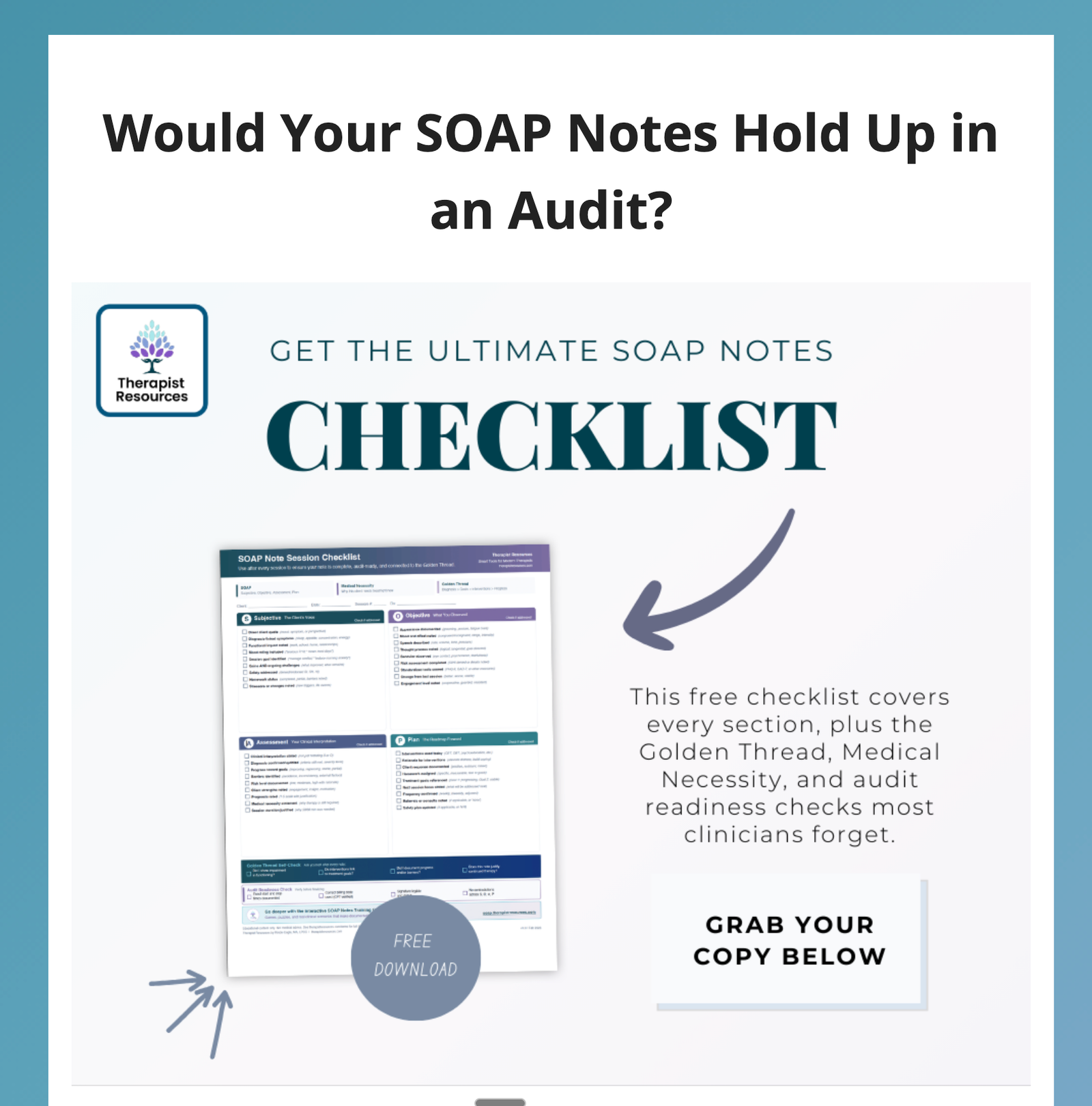
The free SOAP Notes Session Checklist provides a section-by-section prompt structure that covers every audit-required element. Use it for one week of notes. The gaps, if they exist, will show up quickly. The SOAP Notes Training Course covers the complete documentation framework, including golden thread, medical necessity, and SOAP structure, with examples across modalities and note types.
Rindie Eagle, MA, LPCC is a licensed professional clinical counselor, clinical supervisor, and co-creator of the SOAP Notes Training Course alongside Renee Divine, MA, LMHC.
Discover more from The Happy Brain Universe
Subscribe to get the latest posts sent to your email.
Leave a Reply