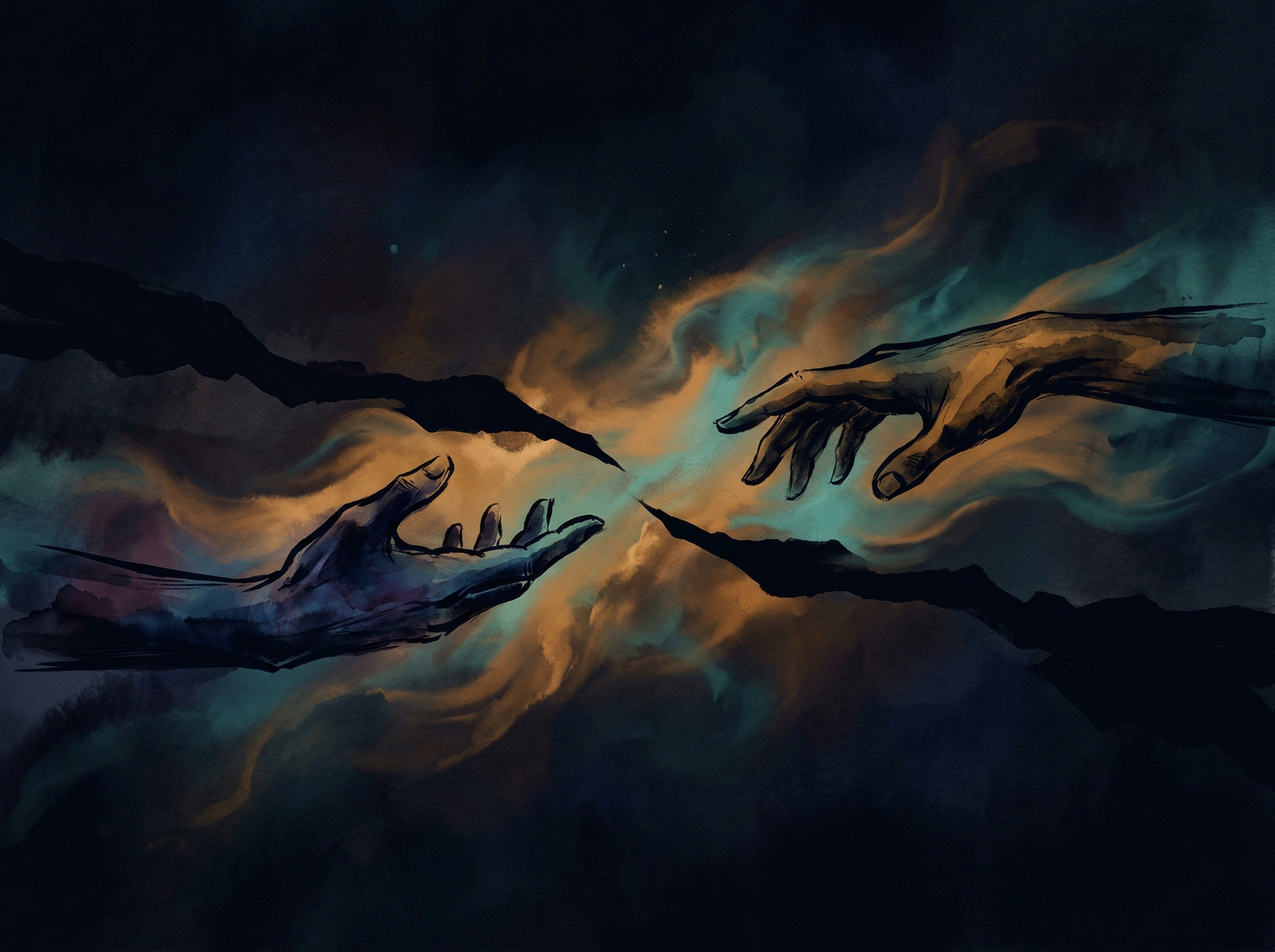
We are excellent at seeing what is wrong. Scroll through any comments section. Listen to your own inner monologue for five minutes. We notice the problems, the gaps, the failures. We notice them in the world, in other people, and (especially) in ourselves.
That ability to recognize what needs fixing is genuinely useful. Therapists do it for a living. Scientists build careers on it. Progress depends on people who can look at something broken and name it clearly.
But there’s a trap. Recognizing what is wrong can start to feel like enough. You see the problem. You name it. You might even post about it. And then you stop there. The criticism becomes the contribution.
Alfred Adler asked a question over a hundred years ago that still lands. He put it plainly: “It is not enough only to recognize the bad, and condemn it. We must ask ourselves, ‘What have I done to make things better?’”
That question shifts everything. It moves you from observer to participant. And the neuroscience backs up why that shift matters so much.
Why Contribution Feels Good (The Neuroscience)
Making others’ lives better is not just a moral ideal. It is a biological event.
In 2006, neuroscientist Jorge Moll and his team at the National Institutes of Health ran an fMRI study where participants decided whether to donate money to charity or keep it for themselves. When participants chose to give, the mesolimbic reward pathway activated. That is the same brain circuitry that lights up when you eat food you love or experience social bonding. Generosity triggered the same neural response as receiving a reward.
Elizabeth Dunn at the University of British Columbia and Michael Norton at Harvard Business School found something similar. In a 2008 study published in Science, they showed that spending money on other people predicted greater happiness than spending the same amount on yourself. This held true regardless of income level. The amount did not matter. The direction of the generosity did.
And the effects go beyond a momentary feel-good response. A 2013 meta-analysis published in BMC Public Health (Jenkinson et al.) found that volunteering was associated with reduced depression, greater life satisfaction, and lower mortality risk. Helping others is literally good for your health.
Your brain releases oxytocin during prosocial behavior, which buffers cortisol and calms the stress response. Contributing to someone else’s well-being sends your nervous system a signal that things are okay. That you are connected. That you belong.
Adler called this Gemeinschaftsgefühl (social interest). He believed it was the foundation of mental health. Neuroscience now has the brain scans to prove he was onto something.
What It Looks Like When Someone Answers the Question
Adler’s question is easy to agree with. Harder to act on. So it helps to see what it looks like when someone actually does it.
If you have not seen Project Hail Mary yet, go. It is one of the best films in years, and it happens to be a two-hour answer to Adler’s question.
Ryland Grace (Ryan Gosling) is an ordinary middle school science teacher who wakes up alone on a spaceship with no memory of how he got there. Earth is dying. A microorganism called Astrophage is consuming the Sun’s energy, and the planet has roughly 30 years before it is uninhabitable. Grace was sent on a one-way mission to find a solution.
Then he discovers he is not alone. Rocky, an alien from the 40 Eridani system, is on a parallel mission to save his own world. They cannot breathe the same air. They do not share a language. They have no biological reason to trust each other. They build a partnership anyway.
Screenwriter Drew Goddard called courage and empathy the superpower of the movie. Director Phil Lord said, “We are permeated by messages about how divided we are. It really is useful to imagine what we can accomplish together.”
Here is what makes the film hit so hard: Grace was afraid. Through the entire story, he was terrified. He did the things anyway. When he faced the choice between going home and staying behind to save Rocky’s world too, he chose contribution. He answered Adler’s question with his entire life.
That is courage. Feeling the fear and acting anyway. And that is the best way to show up in this life.
The Question Is Not Hypothetical
You do not need a spaceship to answer Adler’s question. Contribution scales down.
Check in on someone who has been quiet lately. Show up for a friend’s event (even when you are tired and would rather stay home). Share something you learned that made your own life a little easier. Volunteer an hour of your time. Ask a colleague how they are doing, and actually wait for the answer.
These are not grand gestures. They are small, courageous acts of showing up for other people. And each one activates the same reward circuitry that Moll’s team measured in the fMRI scanner.
If you are someone who struggles with perfectionism, you might feel a pull to contribute perfectly or not at all. That is the pattern talking. Contribution does not require perfection. It requires movement. One text. One conversation. One hour.
A little courage goes a long way. And courage is contagious. When you show up afraid and do the thing anyway (the way Grace did), other people notice. It gives them permission to do the same. Your courage becomes someone else’s starting point.
Start Moving
Adler’s question does not expire. It is sitting there right now, waiting for you.
You do not have to save a planet. You just have to do one thing today that makes someone else’s day slightly better. Be afraid and do it anyway. A little courage goes a long way. And your brain will reward you for it.
The neuroscience in this post is drawn from: Jorge Moll et al., “Human Fronto-Mesolimbic Networks Guide Decisions About Charitable Donation,” Proceedings of the National Academy of Sciences (2006); Elizabeth Dunn, Lara Aknin, and Michael Norton, “Spending Money on Others Promotes Happiness,” Science (2008); and Caroline Jenkinson et al., “Is Volunteering a Public Health Intervention?” BMC Public Health (2013). The Alfred Adler quote appears in What Life Should Mean to You (1931). Film references are from Project Hail Mary (2026), directed by Phil Lord and Christopher Miller.
If helping others feels impossible right now because you are barely holding on yourself, that is a signal to reach out for support. A therapist can help you get back to solid ground. You do not have to contribute your way out of a crisis alone.
Discover more from The Happy Brain Universe
Subscribe to get the latest posts sent to your email.
Leave a Reply