What Nobody Tells You About Neurofeedback Certification
I am a licensed therapist with over a decade of clinical experience. I have been studying for BCIA and IQCB board certification in neurofeedback and QEEG for about 8 months. And I can tell you with confidence that the learning curve is steeper than anything I encountered in graduate school.
That is not a complaint. It is context. Because if you are a clinician considering neurofeedback certification, you deserve an honest picture of what the journey actually involves. Most of the marketing around training programs emphasizes the exciting parts (brain maps, real-time feedback, helping clients in a new way) without spending much time on what happens between “I signed up for a course” and “I feel competent.”
The Scope of What You Are Learning
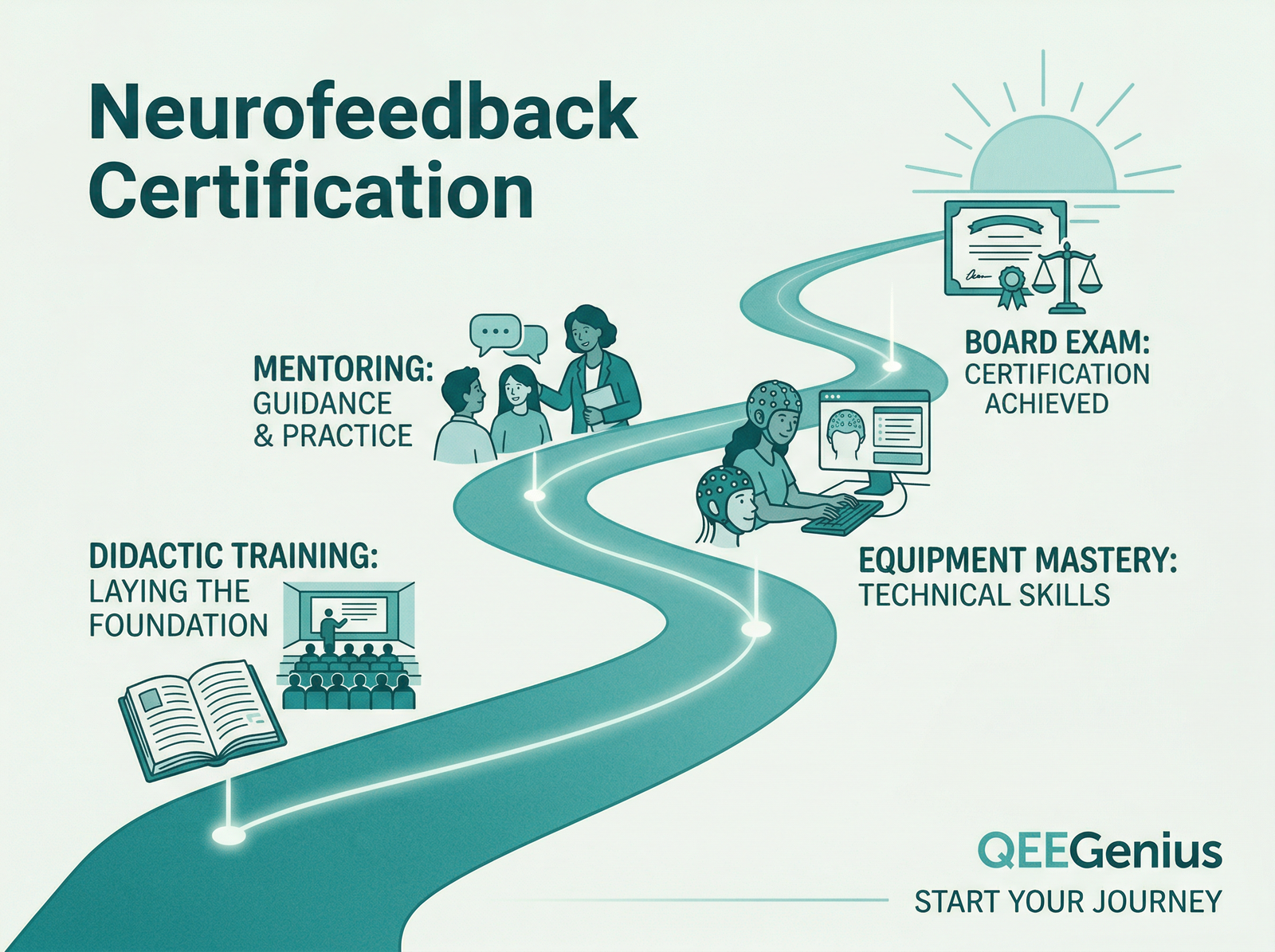
Neurofeedback certification is not a weekend workshop. The BCIA Board Certified in Neurofeedback (BCN) pathway requires 36 hours of didactic training aligned to a specific blueprint of knowledge, a separate neuroanatomy course, and 25 mentoring contact hours that include 100 client sessions across at least six different clients over a minimum of ten weeks. You also present ten detailed case studies to your mentor before sitting for a proctored exam.
The IQCB pathway for QEEG certification (whether you pursue the QEEG-T, QEEG-D, or QEEG-DL designation) adds 40 hours of didactic coursework on a different blueprint, 10 mentoring hours with an IQCB Diplomate reviewing data analysis and report writing, and another proctored exam with a 70% passing threshold.
Those are the minimum requirements. They do not include the hundreds of hours you will spend reading textbooks, reviewing EEG recordings, troubleshooting equipment, and trying to make sense of concepts that have no parallel in traditional clinical training.
Where Therapists Get Surprised
If you trained as a therapist, you learned to listen, conceptualize, intervene, and document. You understand human behavior, diagnostic frameworks, and therapeutic relationships. None of that prepares you for impedance checks.
Here is where the surprises tend to land:
You become a technician. Neurofeedback requires hardware. You will learn electrode placement using the 10-20 International System, skin preparation techniques, impedance testing, and signal quality troubleshooting. When a signal drops mid-session because a sensor shifted, you need to fix it. When your software displays unexpected artifact, you need to know whether it is muscle contamination, a 60 Hz electrical interference pattern, or an actual EEG anomaly. This is a different skill set than anything in a counseling program.
The neuroscience goes deep. BCIA and IQCB curricula cover neuroanatomy, thalamocortical relay systems, neurotransmitter pathways, Brodmann areas, cortical generators, and the mathematical foundations of quantitative EEG analysis. You will learn about Fourier transforms. You will learn about coherence, phase lag, and Z-scores. If you have not taken a neuroscience course since graduate school (or ever), this material demands sustained focus.
Protocol selection is not intuitive. Choosing the right neurofeedback protocol for a client involves integrating QEEG findings with clinical presentation, understanding which brain regions and frequency bands to target, and knowing when to adjust. There is no flowchart that covers every scenario. The clinical judgment you build takes dozens of cases and ongoing mentorship, not just a course.
The equipment learning curve is real. Clinical-grade QEEG systems like BrainAvatar and Discovery hardware are powerful and complex. The software alone can take months to navigate confidently. Add NeuroGuide for analysis, a separate platform for home training, and the various settings and configurations each system requires, and you are managing a technical ecosystem on top of your clinical work.
What the Timeline Actually Looks Like
Training programs vary, but here is a realistic picture for a licensed therapist pursuing dual BCIA BCN and IQCB QEEG certification while maintaining a clinical caseload:
- Months 1 to 3: Didactic coursework. You are absorbing content. You understand some of it, reference-check the rest, and wonder what you signed up for at least twice.
- Months 3 to 6: Mentoring begins. You start running sessions with real clients under supervision. Equipment failures happen. You troubleshoot. Your mentor corrects your protocol reasoning.
- Months 6 to 12: You develop rhythm. Sessions feel less like controlled chaos. You start recognizing EEG patterns without your cheat sheet. You are still studying.
- Month 12 and beyond: Exam preparation. Case study documentation. The gap between “I completed the requirements” and “I trust my own clinical judgment with this modality” starts to close, but it does not close overnight.
Some clinicians complete certification in under a year. Many take 12 to 18 months, especially when balancing a full clinical caseload.
Why It Is Worth Saying Out Loud
The neurofeedback field does not always talk about how hard the learning curve is. There are good reasons for that. Training programs want to attract students. The field wants to grow. Nobody benefits from scaring people off before they start.
But here is what I have learned from going through it: the difficulty is not a sign that something is wrong. It is a sign that you are learning a genuinely technical clinical skill. You are adding a modality that requires knowledge of neurophysiology, signal processing, and clinical decision-making at a level most therapy training programs never touch.
The clinicians who do well in this field are the ones who expected it to be hard and showed up anyway. Not because they were naturally gifted at reading EEGs, but because they stayed in the process long enough for competence to build.
What Would Have Helped Me
Looking back on my own certification journey so far, a few things would have made the path smoother:
- A realistic timeline. Knowing that 12 to 18 months is normal would have reduced the pressure I put on myself early on.
- Peer connection. Other clinicians going through the same thing. The isolation of learning a technical skill inside a therapy practice is real.
- Structured study materials. The textbooks are dense. Organized cheat sheets and study guides that break concepts into manageable pieces save hours of re-reading.
- Permission to be a beginner. I have been a clinician for years. Being new at something again is uncomfortable. It is also the only way forward.
If you are considering this path, go in with your eyes open. The certification requirements are achievable. The learning curve is real. And the ability to offer brain-based assessment and training to your clients is worth the work it takes to get there.
Rindie Eagle, MA, LPCC
QEEGenius | qeegenius.com
Discover more from The Happy Brain Universe
Subscribe to get the latest posts sent to your email.
Leave a Reply